Lobuche Peak Climbing - 17 Days

Trip Facts
Duration 17 Days
Max Altitude 6,119m
Trip Grade Challenging
Best Season spring (March to May) and autumn (late September to November)
Meals Breakfast In Kathmandu & Breakfast/Lunch/Dinner while in Trekking
Accommodation Hotel In Kathmandu/ Teahouse&tent while in Trekking
Highlights

Lobuche Peak Climbing Highlights

  • Enjoy 30 minutes Scenic flight from Kathmandu to Lukla - Tenzing Hillary Airport.
  • Trek through the Sagarmatha National Park - a UNESCO World Heritage Site
  • Pass through famous Sherpa villages such as Namche Bazar and Gorakshep.
  • Reach Everest Base Camp and hike to Kala Patthar for a close view of Mount Everest and a breathtaking sunrise view over the Himalayas.
  • Learn basic mountaineering skills from a professional trainer.
  • Reach the Lobuche Peak summit through the east route and enjoy close-up views of Mount Everest, Lhotse, Nuptse, Ama Dablam, and Makalu, including the Khumbu Glacier and surrounding peaks.
  • Experience the hospitality of the Sherpa people and enjoy famous Sherpa food such as Shakpa (Sherpa Stew) and Tsampa.
  • Enjoy the mountain lifestyle, local culture and traditions.
Overview

Lobuche Peak Climbing Overview

Lobuche Peak Climbing (6,119 m) is one of the most popular trekking peaks in Nepal, situated in the Khumbu region. Our 17-day Lobuche Peak Climbing Package combines the classic Everest Base Camp trek with a moderately technical climb to the Lobuche summit. This journey is ideal for climbers seeking their first alpine climbing experience.

This (trekking + climbing) journey takes you to some of the highest places on earth, rewarding you with stunning views of the Nepalese Himalayas. It takes you to the legendary Everest Base Camp and a hike to Kala Patthar to enjoy the sunrise and a close view of mighty Mt. Everest. Other notable peaks you will witness are Lhotse (8,516m), Nuptse (7,861m), Ama Dablam (6,812m), Pumori (7,161m), Thamserku (6,623m), Kangtega (6,782m), Island Peak (6,189m), and many more.

Home to the legendary Sherpas, the Lobuche East Peak in the Khumbu region also offers rich culture and traditions. Scenic mountain views, the famous Hillary suspension bridge, teahouse experience, waterfalls, main walls, monastery- there are lots of things to see and experience in this adventure.

Your journey of the climbing starts by taking a domestic flight from Kathmandu/Manthali airport to Lukla. Then, for several days, you will trek in the Sherpa village. Then, after learning mountaineering skills from our expert team, you will head for the Lobuche East summit push. You will stay in high-altitude tents, with our experienced guides ensuring your safety, comfort, and support throughout the climb.

Then, after the successful summit, you will return home safely with a lot of memories that you made during this wonderful adventure. 

We have carefully planned this itinerary so that it remains suitable for beginners who want to introduce themselves to peak climbing. You will have enough time to explore the beauty of the Everest region, acclimatize properly and enjoy fully. 

Major Attraction of Lobuche Peak Climbing

Here are the top attractions of the Lobuche Peak Climbing that make every penny of your investment truly worth it:

Spectacular Panoramic Views:

From the moment you leave Lobuche Base Camp at 5,200 m, stunning mountains will surround you. Peaks like Mt. Ama Dablam, Island Peak (Imja Tse), and the Khumbu Glacier stretching down into the valley create an amazing view. On clear days, you can even see the distant outline of Mt. Everest, with clouds swirling around its summit.

Visit Iconic Destination: Everest Base Camp and Kala Patthar:

The classic Everest Base Camp trek is the heart of the Lobuche adventure. Follow ancient Sherpa trade routes, cross suspension bridges, and walk trails used by legendary climbers. Even without climbing Everest, a short hike to Kala Patthar (5,643 m) offers one of the best views of Everest before heading to Lobuche Peak summit.

Sherpa Culture & Villages:

During the trek, you’ll stay in traditional sherpa teahouse such as Phakding, Namche Bazaar, Dingboche and Ghorakshep. You’ll also visit Buddhist monasteries, prayer halls, mani walls, and the impressive Tengboche Monastery at 3,870 m.

Thrilling Lukla Flight:

There are only a few flights in the world that give you both thrill and adventure. Among them, the Lukla flight ranks at the top of the list. You will land at Lukla Tenzing Hillary Airport, which has a short runway and is surrounded by giant hills and mountain peaks.

Trek Inside Sagarmatha National Park:

Another best part of doing the Lobuche Peak climbing is that you will trek inside the Sagarmatha National Park, which is a biodiversity hotspot. It is home to endangered species such as the snow leopard, red panda, Himalayan tahr, and musk deer. Also, trekking through a colorful rhododendron forest, oak and pine trees is full of fun for nature lovers.

Adrenaline-Fueled Peak Climb:

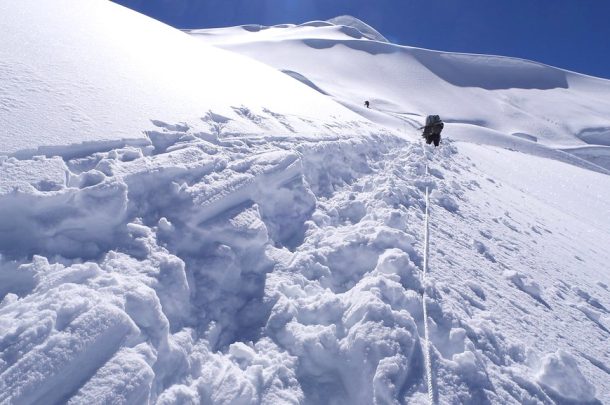
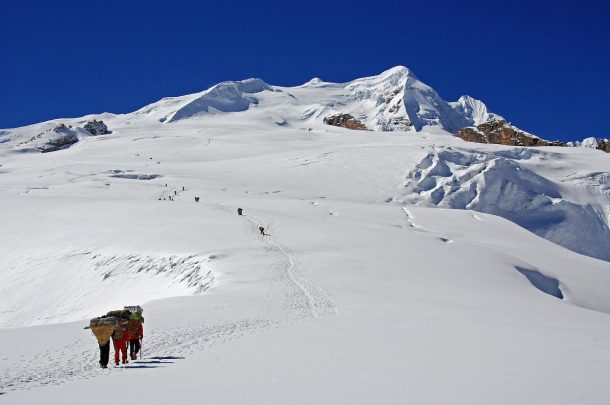
Lobuche is classified as a “trekking peak” in Nepal. Even though it’s not technical, you will get the opportunity to learn the use of crampons, an ice axe, and a short rope. The ascent involves glacier travel, a modest crevasse‑crossing, and a short rock scramble. It will help to gain experience for future expeditions such as Ama Dablam, Manaslu and Everest.

Why Choose High Route Adventure For Lobuche Peak Climbing?

Lobuche Peak Climbing
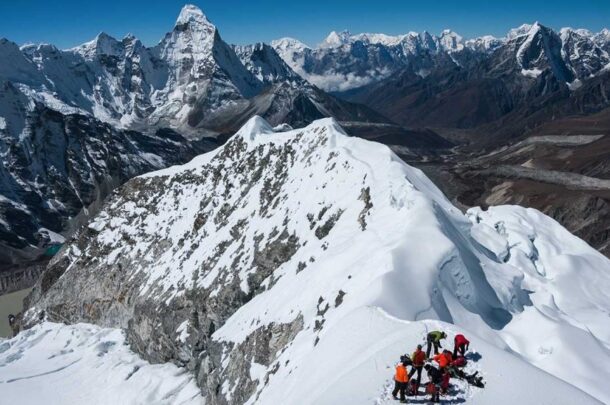
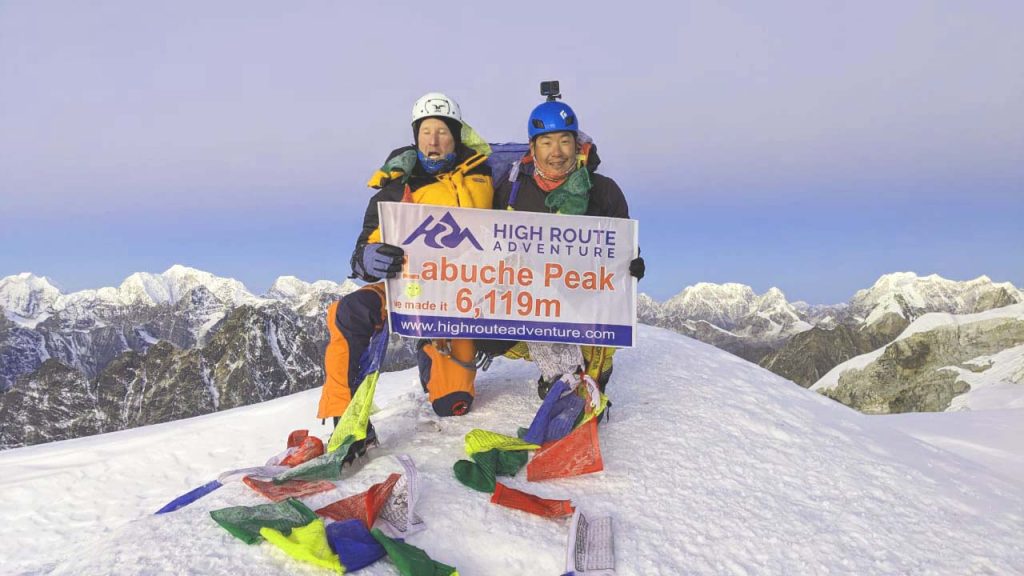
Climbing Lobuche Peak (6,119m) with stunning Himalayan views.

Choosing the High Route Adventure means you not only book a trip with us- it’s about securing safety, being well-organized, and having a lifetime experience. Let’s see what are the advantage you will get when you make us your travel partner:

➡️Local Expertise: We are one of the leading trekking and tour operators in Nepal with 15 plus experience. We have completed numerous high-altitude treks and expeditions in Nepal with a proven record of safety and success.

➡️Safety‑First Philosophy: To guarantee your safety, we provide you only highly trained, experienced Sherpa guides. All HRA guides are certified by the Nepal government. 

➡️Tailored Acclimatization: Whether you want to visit the breathtaking Gokyo Lake or the challenging Chola Pass as a side trip during Lobuche Peak Climbing. You can customize the itinerary as per your interest and choice.

➡️All‑Inclusive Packages: From Lobuche Peak Climbing permit, logistics, food, accommodation, guide, porter, flights and supportive staff, we manage all these things for you.

➡️Eco‑Conscious Operations: HRA follows a “Leave No Trace” policy, carries out all waste management, and supports local conservation projects (e.g., Khumbu Village clean-up).

➡️Post‑Climb Support: High Route Adventure assists you with future trip planning, helping you build your climbing roadmap and keep your spirit of adventure alive even after the journey ends.

Lobuche Peak Climbing Cost for 2026/2027

The cost of climbing Lobuche Peak starts at USD 2,780 per person. This price includes a round-trip flight to Lukla, climbing permits, ground transportation to the airport, a guide, supportive climbing staff, a porter, meals, and accommodation in teahouses. If you are part of a group, we also offer group discounts. Additionally, you can make a booking for the year 2027 at the current price for 2026.

Let’s see the cost according to the group size.

No of PeoplePrice in USD
1 – 1$ 2545 USD
2 – 6$ 2250 USD

Related Articles

Itinerary

Lobuche Peak Climbing Itinerary

Duration: 30 minutes
Distance: 5.9 km
  • Meet our representative at the airport.
  • Transfer to your hotel in our private vehicle.
  • Later in the evening, meet our tour operator for a comprehensive trip briefing, followed by a welcome dinner.
  • Overnight stay at your hotel.

Traveler’s Note: Please prepare for tomorrow's early morning flight. Ensure your bags are ready, and have your documents, permits, and local cash for personal use. If your flight departs from Manthali Airport, please arrive at the bus departure point before 2 AM.

⛰ Altitude 1,350 m
🍽 Meals Breakfast
🏨 Stay Hotel
Duration: 3 to 4 hours
Distance: 7.5 to 8 km

Flight Duration: 30 minutes

  • Enjoy an early breakfast before getting ready for the drive to Tribhuvan International Domestic Terminal
  • Meet our Guide and Driver at your hotel and ride toward the airport
  • Complete Checking and board the plane for the scenic flight toward Lukla Airport.
  • Land at Lukla Tenzing Hillary Airport, check out and start your trekking with your team.
  • Head along the Dudh Koshi River
  • Pass through Cheplung, Thado Koshi, Ghat and arrive at Phakding Village.

Traveller’s note: Did you know that Lukla Airport is the world’s 38th-highest airport? The Dudh Khosi River, meaning the Milk-Khosi River, got its name due to its white water and is one of the highest rivers in terms of elevation.

⛰ Altitude 2,780m
🍽 Meals Breakfast/Lunch/Dinner
🏨 Stay Teahouse
Duration: 5 to 6 hours
Distance: 11 to 11.5 km
  • After breakfast at the Phakding teahouse, begin your hike to Namche Bazaar.
  • Follow the bank of the Dudh Koshi River and pass through small villages like Toktok and Benkar.
  • Arrive at Monjo, show your permit at the checkpost and enter Sagarmatha National Park.
  • Walk through the riverbed, reach Jorsalle and then cross the famous Hillary Suspension Bridge.
  • Trek through thick pine and rhododendron forest and arrive at Namche Bazaar

Traveller's Note: Namche Bazaar is the main hub of the Khumbu region, offering ATMs, banks, bakeries, cafés, medical clinics, pharmacies, trekking gear shops, and local stores. If you're here on a Saturday, you can also visit the famous Namche Saturday Market.

⛰ Altitude 3,440m
🍽 Meals Breakfast/Lunch/Dinner
🏨 Stay Teahouse
Duration: 5 to 6 hours
Distance: 9 to 10 km
  • Hike up to the Everest View Hotel for breakfast with a stunning sunrise view.
  • Enjoy a delicious breakfast in a hotel while admiring the breathtaking sights of Mount Everest (8,848 m), Lhotse (8,516 m), and Ama Dablam (6,812 m).
  • After breakfast, continue your hike towards Khumjung Village, where you can visit the Khumjung Monastery and explore the surrounding area.
  • Descend to Namche Bazaar, with visits to the Sherpa Culture Museum and Tenzing Norgay Memorial Park.
  • Explore Namche Bazaar

Traveller's Note: Did you know? Hotel Everest View (3,880 m) holds the Guinness World Record as the world's highest-altitude hotel, offering breathtaking views of Mount Everest and the surrounding Himalayas.

⛰ Altitude 3,440m
🍽 Meals Breakfast/Lunch/Dinner
🏨 Stay Teahouse
Duration: 6 to 7 hours
Distance: 9 to 10 km
  • After breakfast leave Namche by heading toward the Portse
  • Reach Kyangjuma and stop for short rest and teabreak
  • Cross the Mong La Pass9 (also known as Mong La Danda) situated nearly at the alitude of 4,000m and enjoy the panoramic view of Ama Dablam, Thamserku, and Kangtega.
  • Trek through pine and rhododendron forests down to the riverbed at Phortse Tenga (3,680m)
  • Cross the bridge over the Dudh Koshi and arrive at Portse Village.

Traveler's Note: Did you know? Phortse is a key junction in the Everest region, where the trail branches west into the spectacular Gokyo Valley along the Gokyo Lake Trek route.

⛰ Altitude 3,850m
🍽 Meals Breakfast/Lunch/Dinner
🏨 Stay Teahouse
Duration: 5 to 6 hours
Distance: 11 to 12.5 km
  • After breakfast, leave Phortse and hike into the hillside above the Dudh Koshi valley.
  • Cross a bridge and visit the historic Pangboche Gompa, the oldest monastery in the Khumbu region.
  • Pass through mani walls and reach Orsho, passing through Somare
  • From Orsho, take the lower trail along the Imja Khola and gradually ascend to Dingboche
  • Arrive at Dingboche village.

Traveler’s note: As you enter the Imja Valley today, you'll likely see herds of yaks grazing along the trail.

⛰ Altitude 4,350m
🍽 Meals Breakfast/Lunch/Dinner
🏨 Stay Teahouse
  • Today, you will have two options for the acclimatization hike; you can choose based on your fitness level and interests.
  • After the hike, return to your teahouse, following the "climb high, sleep low" principle for acclimatization.

Nangkartshang Peak Hike: Hiking Nangkartshang Peak takes 2 to 2.5 hours from Dingboche. The summit offers breathtaking views of Makalu, Lhotse, Cho Oyu, Island Peak, as well as the Imja and Dingboche valleys.

Chhukung Ri Hike: Walking for 1.5–2 hours, you will reach Chhukung Valley, and then, further walking for 2–3 hours, you will reach Chhukung Ri(5,550 m). From the top of Chukkung Ri, it offers the stunning south face of Lhotse, Ama Dablam, Island Peak, Makalu, Baruntse, and the beautiful Imja Valley stretching below.

⛰ Altitude 4,350m
🍽 Meals Breakfast/Lunch/Dinner
🏨 Stay Teahouse
Duration: 5 to 6 hours
Distance: 7.5 to 8.5 km
  • After having breakfast, leave Dingboche and hike toward the village of Lobuche.
  • Walk through Pheriche Valley and the small settlement of Thukla.
  • Continue heading north on flat and gradual upgoing trails to reach Thukla village
  • Pass by the rocky lateral moraine of the Khumbu Glacier to reach Lobuche village.

Traveler’s note: Did you know that we can see incredible views of Mt Cholatse (6,440m/ 21,128ft), Mt. Pumori (7,161m/27,494ft), and Lobuche Peak (6,119m/20,076ft) from Thukla. Also, a memorial site is located here to honor the fallen climbers of the Everest region!

⛰ Altitude 4,910m
🍽 Meals Breakfast/Lunch/Dinner
🏨 Stay Teahouse
Duration: 7 to 9 hours
Distance: 11.5 to 12 km
  • Enjoy Breakfast early in the morning and start your journey toward Gorakshep village.
  • Proceed north along the rugged, rocky terrain, crossing lateral moraines and sandy glacier paths adjacent to the Khumbu Glacier.
  • After trekking for about two hours, we arrive at the Gorakshep teahouse, check in, rest, and have lunch.
  • Hike to Everest Base Camp to take pictures at the iconic stone and enjoy the views from Base Camp.
  • Return to Gorakshep for an overnight stay at the teahouse.

Traveler’s note: The next morning, we will wake up early to hike up to Kala Patthar for a sunrise view. It’s important to ensure that your batteries and headlamps are fully charged, as we will leave while it is still dark.

⛰ Altitude 5,164m
🍽 Meals Breakfast/Lunch/Dinner
🏨 Stay Teahouse
Duration: 4.5 to 6 hours
Distance: 8 to 9 km
  • Wake up around 3.30 am and leave the teahouse by putting on a headlamp.
  • Hike for about 2 hours and reach the Kala Patthar viewpoint
  • Enjoy a breathtaking sunrise view over Mt.Everest and the surrounding Himalayas
  • Descend back down to Gorakshep, walking for about 1 hour
  • Enjoy Breakfast at the Gorakshep teahouse and prepare to leave for Lobuche Village
  • Hike for about 2.5 hour to 3. 5 hour and arrive at Lobuche.

Traveller's note: Kala Patthar, which is situated at an altitude of 5,545 m, is the highest point of this trek. Even though the hike duration is short, it's challenging due to thin air. Walk slowly and carefully without rushing. Take a water bottle and snacks with you.

⛰ Altitude 4,940 m
🍽 Meals Breakfast/Lunch/Dinner
🏨 Stay Tea house
Duration: 4 to 5 hours
Distance: 3 to 4 km
  • Breakfast at Lobuche teahouse and start hiking toward the High Camp.
  • After 3 hours of walking, reach the Lobuche Base Camp (approx. 4,950 m - 4,980 m) for rest and enjoy the packed lunch.
  • After lunch at Base Camp, our expert guide will provide safety training on how to use the crampons, ice axe handling, and fixed-rope climbing techniques.
  • After a training walk of about 2 hours through rocky moraine trails, loose scree, and occasional snow patches, you will climb higher and arrive at High Camp.

Traveler’s note: The next day we ascend Lobuche East Peak; the time of ascending depends on many factors, including the weather situation. Ideally, we would start the climb around 2 to 3 am in the early morning!

⛰ Altitude 5,400m
🍽 Meals Breakfast/Lunch/Dinner
🏨 Stay Tent
Duration: 8 to 10 hours
Distance: 5 to 6 km
  • Wake up around 1 AM or 2 AM and start hiking by putting headlamp.
  • Climb over rocky ridges and snow slopes, using fixed ropes for around 4 hours to reach the summit.
  • Celebrate your success at the summit, capture unforgettable photos and videos, and admire the breathtaking Himalayan views before descending.
  • Return to High Camp via the same route, walking for approximately 2 to 3 hours.
  • Continue walking for approximately 2 hours along the moraine trail until you reach Lobuche Village.

Traveler’s note: The views from Lobuche East summit are breathtaking, and you’ll definitely want to capture them! Views of Mt. Everest (8,848m/29,029ft), Mt. Nuptse (7,855m/25,771ft), Mt. Lhotse (8,516m/27,940ft), and Mt. Cho Oyu (8,201m/26,906ft are the main highlights.

⛰ Altitude 4,940 m
🍽 Meals Breakfast/Lunch/Dinner
🏨 Stay Tea house
Duration: 6 to 8 hours
Distance: 14 to 15 km
  • After Breakfast pass through Shomare and arrive at Tengboche
  • Spent short time to explore the Tengboche monastery(3,867 m) and for luch with amzing view of Ama Dablam.
  • Follow a zigzag forest trail, cross several suspension bridges over the Dudh Koshi River, and arrive at Namche Bazaar.
  • Take a hot shower after a long days and spend wonderful time here.

Traveler’s note: Did you know that Tengboche is famous for its Buddhist Monastery? Here every year pilgrims come to meditate in the Himalayas, and you can feel the peaceful harmony during the night prayers!

⛰ Altitude 3,440m
🍽 Meals Breakfast/Lunch/Dinner
🏨 Stay Teahouse
Duration: 6 to 7 hours
Distance: 18 to 20 km
  • Descend walking through the bank of Dudh Koshi River
  • Arrive at Monjo and exit Sagarmatha National Park
  • Walk through the valley, cross the suspension bridge and arrive at Lukla village.

Traveler’s note: Did you know that while most of the trek is now descending, it can still be strenuous, so always make sure to go at a slow and comfortable pace!

⛰ Altitude 2,860 m
🍽 Meals Breakfast/Lunch/Dinner
🏨 Stay Teahouse
Duration: Flight - 30 minutes
Distance: 135 to 138 kilometers
  • After enjoying your final breakfast at the teahouse in Lukla, check in at the airport for your flight to Kathmandu.
  • Board the flight, enjoy the spectacular Himalayan views, and bid farewell to the Everest region.
  • After a scenic 30-minute flight, arrive at Kathmandu Airport.
  • Meet our driver upon arrival and transfer to your hotel.

Traveler's Note: As the trekking portion of this package has come to an end, if you have extra time in Nepal, you can extend your stay to enjoy sightseeing tours, day hikes, wildlife safaris, rafting, paragliding, or other adventure activities. We are happy to help you customize your itinerary.

⛰ Altitude 1,350 m
🍽 Meals Breakfast/Lunch/Dinner
🏨 Stay Teahouse
  • Today is a free day to spend at your own leisure.
  • Meet our team representative and enjoy a complimentary spa massage in Thamel.
⛰ Altitude 1,350 m
🍽 Meals Breakfast
🏨 Stay Hotel

Hotel Breakfast + Check-out
• Our team will transfer you to the airport approx. 3hrs before departure
• We hope you enjoyed the Everest Base Camp trek with Lobuche East Peak climbing and look forward to organizing another trip for you

🍽 Meals Breakfast

Build Your Own Adventure!

Collaborate with our specialists to create a unique itinerary.

Lobuche Peak Climbing Booking, Payment and Cancellation
  • Booking: To book the Lobuche East Peak climbing, you can book directly through our website or by contacting us directly on +977-9851058664. If you have any queries or additional requirements, please tell us during booking.
  • Payment: To make a booking, you need to pay an advance payment of 20% of the total trip cost, and the rest of the amount can be paid here in Nepal
  • Cancellation: If you want to cancel the Lobuche Peak Climbing, please read our terms and conditions first and inform us as soon as possible.
Cost Detail

Inclusion

What's included ?

  • Airport pickups and drops in a private vehicle
  • 4-star hotel accommodation in Kathmandu with breakfast
  • Teahouse accommodation during the trek
  • Three Night tented accommodation during the climb
  • All meals (breakfast, lunch, and dinner) during the trek
  • Farewell dinner with cultural program in Kathmandu
  • All ground transportation on a comfortable private vehicle as per the itinerary
  • Domestic flights (Kathmandu- Lukla -Kathmandu)
  • Guided city tour in Kathmandu by private vehicle
  • Entrance fees for sightseeing/monument visits as per the itinerary
  • An experienced, English-speaking and government-licensed trek Guide and climbing Guide
  • Porter service (2 trekkers: 1 porter)
  • Staff costs including their salary, insurance, equipment, domestic airfare, food, and accommodation
  • Down jacket and sleeping bag (Returned after trip completion)
  • All necessary paperwork
  • Labuche peak climbing permit
  • Group mountaineering (climbing) equipment
  • Medical kit
  • All government and local taxes

What's not included ?

  • Nepalese visa fee
  • Excess baggage charge
  • Extra night accommodation in Kathmandu because of early arrival, late departure, early return from mountain (due to any reason) than the scheduled itinerary
  • Lunch and evening meals in Kathmandu
  • International flights
  • Travel and rescue insurance
  • Personal expenses (phone calls, laundry, bar bills, battery recharge, extra porters, bottle or boiled water, shower, etc.)
  • Tips for guide, porter, and driver
Dates

Group Departures

Choose from our scheduled group trips below, or contact us to plan a private or family adventure tailored to your schedule.

Things to Know

Nepal Visa and Passport Information:

To enter Nepal, a tourist visa is required. Foreigners from certain countries can easily obtain a tourist visa upon arrival at Kathmandu Airport (TIA). Indian citizens do not need a visa to travel in Nepal. The cost of the Nepal tourist visa varies depending on the number of days you plan to stay in the country.

  • For 15 Days: Cost USD 30
  • For 30 Days: Cost USD 50
  • For 90 Days: Cost USD 120

Note: You can pay the visa fee in USD, Euro or other accepted currency.  For detail check here: Nepal Country Information

Getting a Local SIM for Communication:

After you arrive at the airport in Nepal and obtain your visa, we recommend purchasing a local SIM card (either Ncell or NTC). With this SIM, you can easily communicate with us and stay in touch with your home country.

To buy the SIM, you will need to present your passport and a passport-sized photograph. The cost for the SIM card is around $1. Additionally, to access data and calling services, you will need to add a balance for basic internet and call packages.

We suggest opting for an NTC SIM, as it tends to work better in the Everest region.

Where to Find Currency Exchange:

You can exchange your foreign currency either at Kathmandu airport or at the foreign exchange counter in Thamel. You can also exchange foreign currency in Namche Bazar, but the exchange rate might be a little higher than in the city area.

  • 1 USD= NPR 147 ( as per 3/20/2026 exchange rate).

Health and Travel Insurance Requirements

To participate in Island Peak Climbing with High Route Adventure, all our clients must submit proof of travel insurance. It is mandatory for your own safety. While purchasing the travel insurance, make sure it covers these things:

  • Emergency medical expenses (hospitalization, treatment, medication)
  • Evacuation and rescue costs (including helicopter rescue from high-altitude areas)
  • Trip cancellation or interruption
  • Lost or delayed baggage
  • Accidental death or disability

Note: If you need travel insurance that covers this climbing expedition, we will be happy to guide you in choosing a suitable policy.

Use of Drone During Lobuche Peak Climbing:

Use of drones without a permit inside the Sagarmatha National Park is illegal. If you want to use the drone, it is compulsory to get a drone permit to avoid legal issues and hefty fines. If you are interested in getting a drone permit, you can contact us.

Required Permits for the Lobuche Peak Climbing:

Here are the required permits you will need:

  1. NMA Climbing Permit (Lobuche East):
  2. Sagarmatha National Park Entry Permit:
  3. Khumbu Pasang Lhamu Rural Municipality Entrance Permit:

Note: High Route Adventure will arrange all these permits, and the cost of all these permits will be included in our package. To obtain the permit, you need to send us your passport and a PP-size photograph. Please note that these permits are valid for single entry only.

Guest Requirements

Lobuche Peak climbing might not suit all adventure lovers, so before planning to undertake you must check whether it suits you or not. This trip is best only for those who have: 

  • The Cardio Baseline: Those who can walk at high altitude for an average of 6-7 hours during the trek and 8-10 hours during the summit push and return to base camp.
  • Leg Endurance: Participants should have good stamina and strong legs to manage the steep uphill and downhill sections.
  • Mountaineering Skills: You should learn how to use the ice axe, crampons and ropes. If you have previous climbing experience, it will be a big advantage for you.
  • Mentally Prepared: Climbing Lobuche is your choice, but returning safely is mandatory, so you must be mentally prepared to face challenges and handle tough situations during the adventure.
  • Good health: Climbers must be in overall good health with no underlying serious health conditions, such as heart, lung, or severe respiratory issues.
  • Experience: Lobuche Peak Climbing is not suitable for first-time trekkers or beginner trekkers who have little knowledge of high altitude experience.

Notes

How Hard is Lobuche Peak Climbing?

Lobuche East Peak climbing is classified with an Alpine Grade of PD, indicating that it is challenging but easier than climbing Lobuche West. Beginner trekkers can successfully undertake this trekking peak by maintaining good fitness and possessing basic mountaineering skills. Let’s explore the common challenges you may encounter during Lobuche Peak climbing.

  • High Altitude and Thin Air: While heading for the Lobuche East summit, which stands at an altitude of 6.119 m due to thin air, trekkers need to deal with altitude sickness(AMS). Altitude sickness can happen to anyone at any time above 3,500 metres, and if not taken care of in the early stages, it can result in HACE and HAPE, which are the deadly forms of AMS.
  • Unpredictable Weather: Weather in Nepal, especially in high-altitude mountain areas, is unpredictable. If the weather turns bad, then climbers need to deal with heavy snowfall, strong wind, slippery and risky trails due to heavy rainfall. Weather changes can also result in poor visibility and temperature fluctuations, which can delay climbs or make conditions dangerous.
  • Technical Terrain: During the climbing period from the Lobuche East Base Camp toward the summit, the route is steep snow and ice slopes, crevasses, and rocky sections. You need to use an ice axe, crampons, and rope techniques, which can be challenging for beginner trekkers. 
  • Physical Endurance: It is important to have good stamina for climbing Lobuche Peak. You must be able to walk for an average of 6-7 hours every day and extended hours up to 8-10 hours during summit days. If you don’t have good stamina, cardio and strong legs, it can be really exhausting and tiring.
  • Limited Rescue Options: At the high altitude of the Khumbu region, it will be really difficult to do a rescue. The only option is helicopter evacuation. Additionally, there are no advanced hospitals in the Everest region, so transfer to Kathmandu hospital is required.
  • Glacial Hazards: In some sections, you need to cross glaciers with hidden crevasses. If you don’t walk carefully or use proper safety techniques, there is a risk of falling into crevasses, which can lead to serious injury or worse.

How To Prepare Physically for Lobuche Peak Climbing?

The primary focus before attempting Lobuche Peak Climbing should be on maintaining physical fitness. Here are some essential tips to help you stay fit.

  • Cardiovascular Endurance (4-5 days/week): Do activities that get your heart pumping for 45–60 minutes, like running, cycling, or rowing. Mix easy, steady sessions with high-intensity intervals (like 4 minutes fast, 3 minutes slow, repeat 4 times).
  • Strength Training (Legs & Core): Train your legs and core 3 times a week. Do squats, lunges, step-ups (with 15–20 kg weight if possible), and deadlifts, 3 sets of 12–15 reps. Strengthen your core with planks, side planks, hanging knee raises, and Russian twists-hold each for 30 seconds.
  • Endurance Hiking: Go on long hikes with a backpack weighing around 12–15 kg. Do one long hike each weekend, slowly increasing distance to 20–25 km and climbing up to 1,500 m. Practice going up and down hills to teach your legs to recover on descents.
  • Flexibility & Mobility: Stretch before and after exercise to keep your joints moving and avoid injuries. Warm up with leg swings, hip circles, and walking lunges. Cool down with hamstring, calf, hip, and back stretches. Doing yoga once a week can improve balance and help you breathe better at high altitude.
  • Acclimatization & Altitude Preparation: If you can, spend a night or two at high altitude before your climb. You can also use a hypoxic mask during cardio to simulate thinner air. Focus on staying hydrated, eating iron-rich foods, and taking Vitamin C and B-complex supplements to support your red blood cells.

Other Crucial Preparations:

  • Respiratory Training: Train your breathing muscles with an Inspiratory Muscle Trainer for 15 minutes, 5 days a week. Practice deep breathing: inhale 4 seconds, hold 2, exhale 6. This helps your body use oxygen efficiently when the air is thin near the summit.
  • Mental Preparation: High-altitude climbing is challenging mentally. Spend 5 minutes each day visualizing the route, each step, and reaching the summit. Try meditation or progressive muscle relaxation to stay calm, focused, and strong during the climb.

Best Season for Lobuche Peak Climbing

The best times to climb Lobuche Peak (6,119 m) are during the spring (March to May) and autumn (late September to November). These months provide stable weather, clear skies, and excellent visibility of renowned peaks such as Everest, Lhotse, Nuptse, and Ama Dablam, as well as other Himalayan mountains. Spring offers pleasant daytime temperatures and colorful rhododendron forests, while autumn offers crisp mountain views and dry trail conditions following the monsoon.

The ideal climbing window is from late September to early November, when the weather is most stable and visibility is at its peak. The monsoon season (June to August) is not recommended due to heavy rainfall, poor visibility, and an increased risk of avalanches and rockfalls. Winter (December to February) brings extreme cold and harsh weather, making it suitable only for highly experienced mountaineers.

  • Regardless of the season, proper acclimatization and flexibility in your itinerary are essential for a safe and successful summit.

Average Weather And Temperature

Season Day Temperature Night Temperature
Spring(March – May) 5°C to 15°C -10°C to -5°C
Autumn(September – November) 5°C to 12°C -10°C to -5°C
Winter(December – February) -10°C to -5°C Below -20°C (can feel colder with wind chill)
Monsoon / Summer(June – August) 10°C to 20°C 0°C to 5°C

Note: Always check the weather forecast before heading to the summit and during your journey.

Accommodation: What to Expect

On this 17-day Lobuche Peak Climbing, you will stay in the teahouse, and rooms will be shared among the travellers. The room will be prebooked by High Route Adventure for you, and we guarantee the bed will be clean and tidy. You will use the shared toilets, and for the hot shower, you need to pay an extra fee of around USD 1-3 per use. The hot shower facility is limited and available only in the lower Everest region village. Inside the room, you will get a warm blanket, dashna mattress, pillow and bedsheet. For extra warmth, we will provide you with a down jacket and sleeping bag.

Inside the tea house, you can find Wi-Fi and charging facilities, but they charge extra for their use. For Wi-Fi, expect to pay NPR 300 to 500 per hour and for charging, USD 300 to 400 per hour.

  • Note: A private single room is available in the lower region, but their number is limited. If you want a private room, please inform us during booking and remember you need to pay an additional price for this.

Food and Drinks: What to Expect

During the Lobuche Peak climb, you will stay in both teahouses and tents. You can expect a variety of Nepali dishes, along with some international options. However, as you ascend, the menu will become more limited. When staying in tents, meals will be basic, so it’s a good idea to bring snacks or energy bars for extra fuel.

Let’s see the food items you can expect at the teahouse:

Breakfast:

  • Porridge (oats, corn, or rice)
  • Eggs (boiled, fried, or omelets)
  • Toast or bread with jam or butter
  • Pancakes or chapati
  • Tea, coffee, or hot chocolate

Lunch and Dinner:

  • Dal Bhat (rice with lentils, vegetables, and sometimes meat)
  • Soups (vegetable or noodle soups)
  • Momos (steamed or fried dumplings with vegetable or meat filling)
  • Pasta or noodles (in some tea houses)
  • Vegetable or chicken curry with rice

Drinks:

  • Tea, coffee, and hot chocolate
  • Packaged juices
  • Energy drinks or water (boiled or bottled, always check safety)

Altitude Sickness Prevention and Acclimatization Tips

The risk of altitude sickness (AMS) is significant, as you will be trekking above 3,500 meters, with the highest point being the summit of Lobuche Peak at 6,119 meters. Regardless of whether you are an experienced mountaineer or a beginner, anyone can be susceptible to AMS at high altitudes. Therefore, it's crucial to prioritize safety and take steps to prevent AMS. Here are some tips to help you stay safe:

  • Follow the "climb high, sleep low" principle.
  • Walk slowly at your own pace and take breaks whenever you need to rest.
  • Drink plenty of water (3–4 liters/day).
  • Avoid excessive alcohol and caffeine
  • Avoid heavy, greasy meals.
  • Check your oxygen saturation twice a day using a pulse oximeter at altitudes above 3,000 meters.
  • Be vigilant for any symptoms, and if you notice any, inform your trekking guide immediately.Make sure to get plenty of rest and sleep while you're on the trip.
  • To prevent altitude sickness, it's advisable to take medications such as Diamox.

Lukla Flight Booking, Cancellation and Alternatives

The round-trip Lukla flight will be arranged by us, as it is included in the package.

During peak season (spring and autumn), Lukla flights are often diverted to Ramechhap–Manthali Airport instead of Kathmandu. To reach Ramechhap, you'll need to take a bus, which departs at 2:00 AM. Buses are infrequent, so if you prefer more flexibility or comfort, private transportation is available for an extra cost.

Lukla flights are weather-dependent, so delays and cancellations are common. If your flight is delayed or cancelled, you will need to wait until flight operations resume - this can sometimes mean an extra day or more built into your schedule as a buffer.

As an alternative to the fixed-wing Lukla flight, you can take a shared helicopter from Kathmandu (or Ramechhap) to Lukla, which typically costs around USD 500 to 700 per person, subject to availability and seasonal pricing. For detail information check our guide: Kathmandu to Lukla Flight

Who will be in your team during Lobuche Peak Climbing?

When you book Lobuche Peak Climbing with us, your team includes an experienced climbing guide who leads the technical mountaineering aspects and ensures your safety throughout the trip. For larger groups, an assistant guide is added to provide extra support and supervision. Porters accompany the group at a 1:2 ratio, each carrying a maximum weight of 20 kg, so you can trek and climb comfortably without being burdened by heavy loads. A cook and supporting kitchen staff round out the team, preparing fresh, nutritious meals to keep you well-fueled and properly acclimatized at altitude.

Real Story: Anastasia and Lobuche Peak

From “What if I can’t?” to “I did it-again!”

The First Email – A Mix of Excitement and Fear

When Anastasia Ivanova, 31, a graphic designer from Saint‑Petersburg, first wrote to us, she sounded a little frantic. “I’ve done a few high‑altitude treks, but a 6,119‑meter technical climb scares the living daylights out of me,” she typed. She wasn’t asking about the sunrise over the Khumbu Icefall; she was wondering whether her lungs would even cooperate at that height.

Her honesty hit us right away. Lobuche Peak isn’t a “walk‑in‑the‑park” trek. It’s a true alpine climb that demands solid acclimatization, rope work, and, above all, good judgment from both the client and the guiding team.

High Camp– The Moment That Tested Her Resolve

The decisive point of Anastasia’s expedition didn’t come at the summit; it unfolded at High Camp, perched on the lower rim of the saddle that separates Lobuche West from its infamous north face.

On the morning of the Lobuche summit, the sky turned grey, wind gusts picked up, and visibility dropped to a few meters. The weather was not cooperating.  After a quick look at the forecast, they chose to descend, citing “too risky.” Then they told Anastasia to wait until the weather turned good. She was scared and felt that we would return without reaching the summit. 

48 Hours of Patience – The Weather Turns

Anastasia’s guide, Mingma, reminded her: “We’ve already earned the right to be here. The mountain will reward the patience we showed now.”

With fresh packs, new crampons, and a renewed sense of purpose, the team set out for the final push.

The Summit – A Quiet Triumph

On November 12, 2025, at 10:17 am local time, Anastasia stepped onto the summit ridge of Lobuche Peak. She laughed, half‑through the mask, half‑through the disbelief that it was truly over.

She later described the moment:

“I didn’t shout. I just let a single tear slip under my mask, not because I was sad but because I was overwhelmed. My body was numb, the air thin, but looking down at that endless white landscape I knew, unmistakably, that I had earned this.”

Why Anastasia’s Story Matters

Anastasia returned to base camp with no frostbite, no major injuries, and a heart full of confidence. She left the mountain with a fresh perspective on risk management and a newfound respect for the Sherpa team that stayed with her through the storm. Next, she is planning to do Ama Dablam climbing with us.
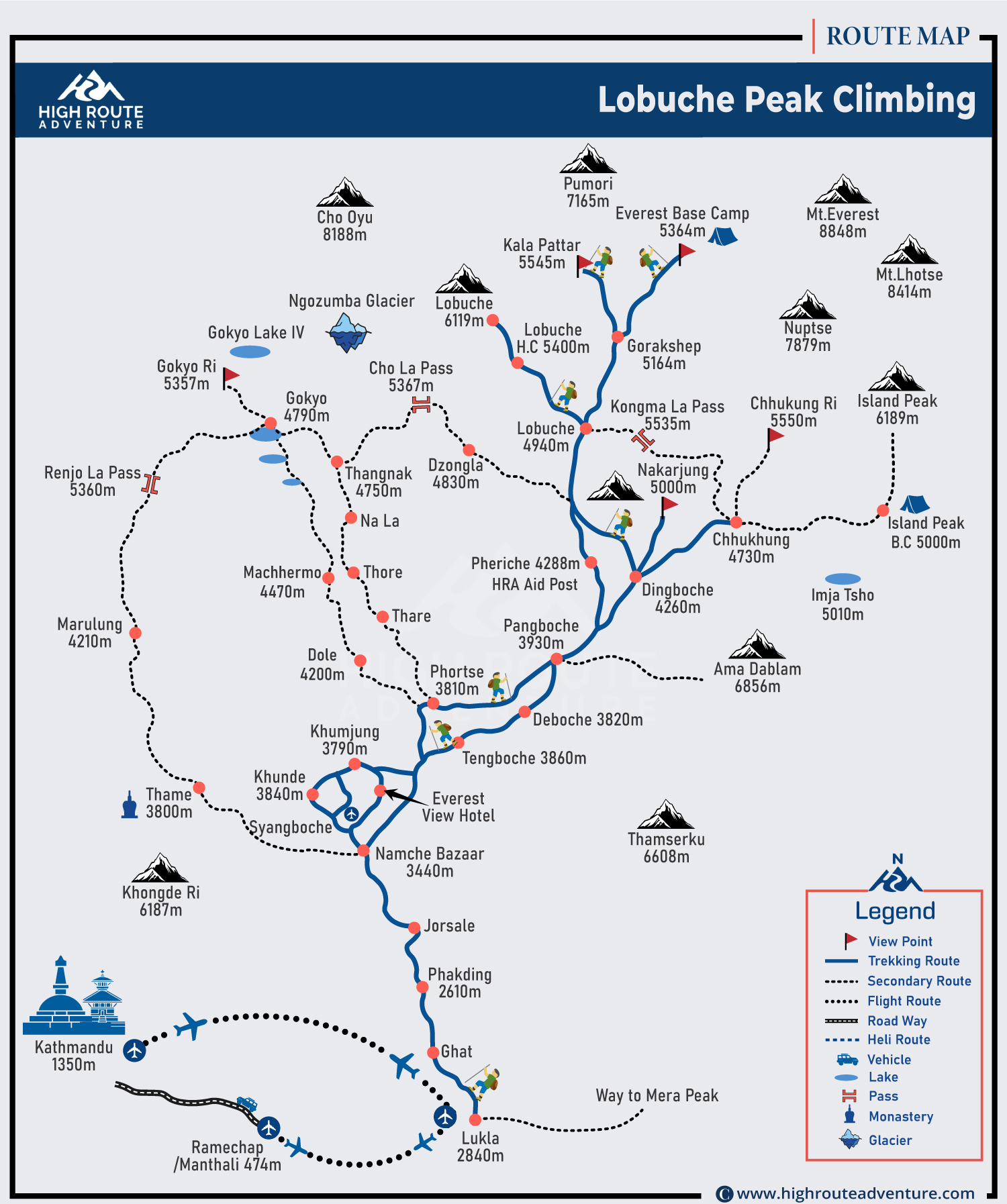
Map

Lobuche Peak Climbing Map

Equipment

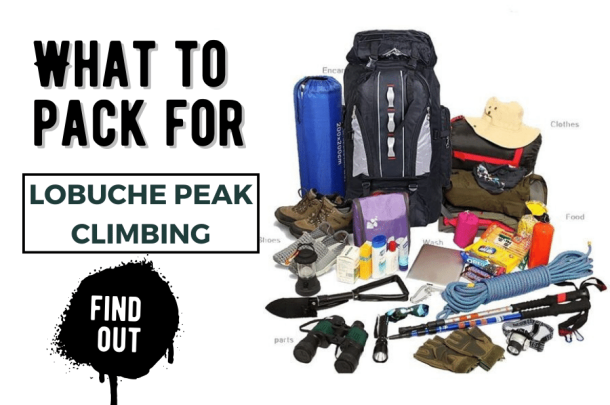
Here's a complete packing list for Lobuche Peak Climbing:

Head & Hands

  • Sun hat / cap
  • Warm wool/fleece hat (covering ears)
  • Balaclava or buff
  • Sunglasses (UV protection, glacier-rated for summit day)
  • Headlamp with extra batteries
  • Lightweight liner gloves
  • Insulated/waterproof mountaineering gloves (for summit push)

Upper Body

  • Thermal base layers (2–3 sets)
  • Light fleece or wool mid-layer
  • Insulated down jacket
  • Waterproof/windproof outer shell jacket
  • Trekking t-shirts (quick-dry, 3–4)

Lower Body

  • Thermal base layer bottoms (2 sets)
  • Trekking trousers (2–3 pairs)
  • Waterproof/windproof shell pants
  • Insulated climbing pants (for summit day)
  • Underwear (moisture-wicking, enough for the trip)

Footwear

  • Trekking boots (broken in, for the approach trek)
  • Plastic/insulated mountaineering boots (compatible with crampons)
  • Trekking socks (wool/synthetic, 4–5 pairs)
  • Thick climbing socks (2–3 pairs)
  • Gaiters
  • Camp shoes/sandals for evenings

Climbing Gear

  • Climbing harness
  • Crampons (fitted to mountaineering boots)
  • Ice axe
  • Ascender (jumar)
  • Figure-8 descender or ATC
  • Locking and non-locking carabiners (3–4 each)
  • Tape sling / prusik cord
  • Climbing helmet

Sleeping & Camping

  • Four-season sleeping bag (rated to at least -20°C)
  • Sleeping bag liner (optional, extra warmth)
  • Sleeping mat/pad (if not provided)

Trekking Equipment

  • Trekking poles
  • Duffel bag (for porters)
  • Daypack (30–40L)
  • Rain cover for bags

Personal & Health

  • Personal first-aid kit (blister care, pain relievers, altitude sickness medication like Diamox -consult a doctor)
  • Water bottles (2 x 1L) or hydration bladder
  • Water purification tablets/drops
  • Sunscreen (high SPF) and lip balm with SPF
  • Personal toiletries and quick-dry towel
  • Hand sanitizer and wet wipes
  • Basic personal medications

Electronics & Extras

  • Power bank
  • Camera (optional)
  • Universal travel adapter
  • Trekking permits, passport copies, and travel insurance documents
  • Cash (Nepali rupees) for personal expenses, snacks, and tips

Documents

  • Passport (with visa)
  • Passport-sized photos
  • Travel insurance covering high-altitude rescue and evacuation
FAQs

FAQs of Lobuche Peak Climbing

  • I have never climbed before. Can I join this peak Climbing?

    Yes, of course. With a great number of climbable peaks available in Nepal, even novice climbers can enjoy a couple of them. Lobuche East Peak is one of those that inexperienced climbers can do; make sure to build up your stamina and fitness before undertaking such an endeavor!
  • When I pay the remainder of the money on arrival in Kathmandu, how does High Route Adventure accept the payment, by card or cash?

    High Route Adventure has both the option of paying by cash in USD or via credit card; do note that by using a credit card, a charge of 4% will be added. There are a couple of ATM's available from where you can take out cash up to a few Percentage and then convert it into USD via a reliable money exchange office. The best and cheapest way to pay the remainder is by bringing the payment with you in cash and paying in our office.
  • What is the altitude of Lobuche Peak?

    Lobuche Peak has two summit points with different altitudes: Lobuche East (6,119 m / 20,075 ft), and the higher, more technical Lobuche West (6,145 m / 20,161 ft).
  • Where is Lobuche Peak located?

    Lobuche Peak is located in the Everest region inside the Sagarmatha National Park close to Mount Everest.
  • Do we need permits for the Lobuche Peak Climbing?

    You will need a climbing permit and several local permits before heading to Lobuche Peak. A trekking agency, such as High Route Adventure, must arrange these permits, as clients cannot obtain climbing permits independently.
  • Can we do solo Lobuche Peak Climbing?

    According to Nepal Mountaineering Association (NMA) rules, hiring a licensed guide is mandatory for Lobuche Peak climbing. Your climbing permit will only be issued if you are accompanied by a licensed guide, which also helps ensure your safety throughout the expedition.
  • Can we see Everest from Lobuche Peak?

    Since Everest is located very close to Lobuche Peak, you can enjoy a great view of Mt Everest.
  • Will I visit Gokyo Lake on Lobuche Peak Climbing?

    No, but if you want you can do a side visit to Gokyo lake we can customize the Lobuche itinerary for you.
  • Is Lobuche Peak climbing harder than Mera Peak Climbing?

    Yes, Lobuche Peak is generally considered more technically challenging than Mera Peak, even though Mera Peak is higher and more physically demanding due to the altitude. Lobuche features steep snow and ice slopes, fixed ropes, and exposed rocky ridges, whereas Mera Peak is mostly a high-altitude glacier walk with less technical difficulty.
  • I'm a beginner trekker. Can I join this trekking peak?

    If you are a beginner trekker with high-altitude trekking experience and have a good fitness level, you can definitely join this Lobuche East Peak Climbing.
  • Do I need to book in advance for Lobuche Peak Climbing?

    Yes, to get the Climbing permit, it takes around 3-5 days, so we request you to book the trek at least 1 week before for a smooth process. Book at least 1 month in advance.
  • Can I customize the itinerary after booking?

    Customizing the Lobuche itinerary before the 30 days of departure date is possible. To know more in details make sure to contact our tour operator.
  • How much advance should I pay for booking confirmation?

    You need to pay 20% of the total trip cost, which you can find on the top right side of the package.
  • Will I get a refund if I cannot complete the summit due to weather issues?

    We will operate the Lobuche Peak Climbing only in good weather conditions. There will be no refund once the trip starts.
  • Is it possible to complete Lobuche Peak climbing in 2 weeks?

    Yes, if you want to complete the Lobuche Peak Climbing in two weeks, you can take a helicopter from either Lukla or Gorakshep.
  • Do I need to carry oxygen for Lobuche Peak Climbing?

    No, normally you don't require an oxygen bottle during Lobuche Peak Climbing. Nowadays you can find portable oxygen bottles you can carry for extra safety.
  • Can I rent the trekking gear for Lobuche Peak Climbing?

    Yes, there are several rental shops in Thamel from where you can rent the trekking gear.

Related Packages

You may like these packages too !
Mardi Himal trek
Trekking in Nepal

Mardi Himal Trek

Short Langtang Valley Trek
Trekking in Nepal

Short Langtang Valley Trek From Kathmandu

3 Day Ghorepani Poon Hill trek Package
Short Treks, Trekking in Nepal

Ghorepani Poon Hill Trek from Pokhara

Everest short trek
Short Treks

Everest Short Trek

Tamang Heritage trek
Trekking in Nepal

Tamang Heritage Trek

Ama Dablam Expedition
Climbing

Ama Dablam Expedition

Chat via WhatsApp +977 9851058664

Our Partners

We are associated with

High Route Adventure TripAvisor Award 2025 High Route Adventure TripAvisor Award 2025