Nepal visa and Passport Information
Foreign citizens travelling to Nepal for the Pikey Peak Trek can obtain a Nepal visa upon arrival at Tribhuvan International Airport (TIA). Travelers can fill out the visa application form using the airport kiosk machines and make the payment based on their intended duration of stay.
- For 15 Days: Cost USD 30
- For 30 Days: Cost USD 50
- For 90 Days: Cost USD 120
Note: To have a smooth immigration process, make sure your passport is in good condition with at least 6 months' validity. For more details check here: Nepal Country Information
How To Book Pikey Peak Trek
To book the High Route Adventure is an easy process:
Step 1: Click on book now, fill the form and send us.
Step 2: Make a payment of 20% as an advance to secure the booking. Once payment is made, we will send you a booking confirmation through email or whatsapp.
To make a payment, we accept:
- Visa and Mastercard
- QR Code & Mobile Banking
- Bank Transfers (connectIPS)
- Cash( if you are already in Nepal)
Cancellation Policy: Our advance payment is non-refundable, so before making a payment, check our terms and conditions
Notes
Pikey Peak Trek Difficulty
The Pikey Peak Trek is rated moderate, with a maximum elevation of 4,065 metres (13,336 ft). It is considerably less demanding than the Everest Base Camp or Annapurna Circuit, making it an ideal gateway for first-time Himalayan trekkers and those with limited time. Most reasonably fit individuals - even without prior high-altitude experience -can complete this trek with proper preparation.
- Elevation Gain: On this 9 Day Pikey Peak trek, you will start your trek from Phaplu, situated at 2,413 meters. The maximum altitude is 4,065 m (Pikey Peak Summit), and altitude sickness risk exists above 3,000 metres. Even though there is a gradual ascent profile, we still need to be careful of AMS by following proper acclimatization plans.
- Distance: The total distance that you will cover on this Pikey Peak trek is approximately 62-66 km in total over 9 days. On average, you will walk for 5-6 hours, which is manageable but still can be tough for the first time trekkers. Trekkers should focus on building physical and overall good health conditions.
- Trail Conditions: The journey includes an off-road drive to reach the trailhead, followed by narrow trekking trails with a mix of gradual ascents and occasional steep uphill sections. The trail condition is walkable for most trekkers with basic fitness. You need to be careful, especially during the monsoon season when the trails become muddy and slippery.
- Weather disruptions: Weather plays a key role in the overall Pikey Peak trekking experience. Bad weather conditions can affect visibility, trail safety, and comfort, especially during the monsoon and winter seasons. Plan your trek when the weather is safe, the temperature is moderate, and you can enjoy the best view of the Himalayan peak.
Pikey Peak Trek Preparation Tips
Solid preparation helps to make your Pikey Peak trekking journey safe, smooth and adventurous. Here is how you prepare:
- Physical Training: Focus on building physical fitness at least 6-8 weeks before the trek. Improve cardiovascular endurance through hiking, stair climbing, or running, and strengthen your legs while developing overall aerobic capacity.
- Break In Your Boots: Many first-time trekkers use brand-new boots directly on the trek, which often leads to discomfort. To avoid this, wear your trekking boots on day hikes well before your departure, as blisters from new boots are one of the most common issues on the trail.
- Pack Smart & Light: Be prepared for all weather conditions, carry essential items such as warm clothing, a waterproof jacket, thermal underwear, trekking poles (optional), a sun hat, a wool hat, a sleeping bag (rated to -10°C), sunscreen SPF 50+, sunglasses, water bottles, and purification tablets. Pack your day backpack only 6-7 kg if you are taking a porter with you.
- Medical Preparation: There are no hospitals, and medical facilities are very limited on the Pikey Peak trekking route. So carry your personal medication with you and purchase travel insurance that covers all trekking risk including helicopter evacuation.
- Cash Is King: There are no ATMs and banks in the Pikey Peak trail, so withdraw enough cash from Kathmandu before heading out for the trip. We recommend that you carry at least 10,000 Nepalese Rupees with you for personal use, tips, and any unexpected situations.
- Electronics: Although there are charging facilities in the teahouse, we recommend that you bring a high-quality power bank with you. It helps to save charging fees at teahouses and helps your device charge throughout the trek.
- Hydration: Drinking water regularly during the treks helps to keep the body hydrated and reduce the effects of altitude sickness. So carry a reusable water bottle and drink enough water.
Best Time For Pikey Peak Trek
To get the best view of the mountain peaks and for the wonderful trekking experience, it is important to choose the right time for trekking. Usually, the best time for the Pikey Peak trek is during the spring (March–May) and autumn(September–November) seasons.
Spring is the season of blooming flowers. The trails will be covered with colorful rhododendron flowers. Also, the rainfall is minimal during this time, and you can have a clear view of mountain peaks due to good weather conditions. Temperature remains moderate during this time.
The most popular hiking time for the Pikey Peak trek is in the autumn season due to good visibility, clear mountain views, moderate temperatures for trekking and chances to witness the biggest festivals of Nepal: Dashain and Tihar.
Trekking Pikey Peak in winter(December to February) is also possible, but trekkers might need to deal with heavy snowfall and extreme freezing weather conditions at high altitude.
We suggest avoiding trekking in the monsoon(mid-June to August) due to heavy rainfall. At this time, the trekking trails become muddy, slippery and poor visibility makes trekking more difficult and less safe.
Accommodation on Pikey Peak Trek
Nowadays, there are plenty of teahouses available in the villages and stopping points along the trail. This teahouse provides facilities to provide a comfortable stay each day after every trek. Teahouses are locally owned, and they offer basic but cozy accommodations with warm hospitality.
Inside the room, there will typically be twin-sharing wooden beds with warm blankets. There will be no AC and heating system inside the room, so we recommend you bring a sleeping bag for cold nights. Most of the teahouse has
Here are the facilities you can get inside the teahouse:
- Wifi: NPR 300-500 per night( connection might be slow and patchy at high altitude)
- Charging: NPR 200- 300 per hour
- Hot shower: NPR 500-600 per use( available only in limited places)
- Shared bathroom
- Communal dining hall
- Central heating system(available only in some teahouses)
Food and Drinks on Pikey Peak Trek
To feed the trekkers during the Pikey Peak teahouse provides a warm and delicious meal for the trekkers. Although the food items might be limited, they provide fresh, organic, and nutritious dishes to keep trekkers energized throughout the journey. There will be veg and non-veg items, but if you have a food intolerance, please inform us in advance so that we can try to make suitable arrangements.
Here are the common menu items you can expect in the Pikey Peak teahouse:
- Dal Bhat – Nepal's traditional meal consisting of lentil soup, steamed rice, seasonal vegetable curry, and pickle. Most teahouses offer unlimited refills, making it the most popular and energy-rich meal on the trek.
- Noodle Dishes – Chow mein, thukpa (Tibetan noodle soup), and instant noodles are commonly available and provide a warm, satisfying meal after a long day of hiking.
- Breakfast Items – Tibetan bread, porridge, pancakes, toast with jam, eggs, and muesli are commonly served for breakfast before starting the day's trek.
- Garlic Soup – A favorite among trekkers, especially at higher elevations. Many believe it helps with acclimatization and altitude adaptation.
- Hot Drinks – Butter tea, Sherpa tea, black tea, milk tea, ginger tea, lemon honey tea, coffee, and hot chocolate are widely available in teahouses.
- Trail Snacks – Energy bars, chocolate, mixed nuts, dried fruits, and biscuits are excellent for quick energy during the trek. Purchasing them in Kathmandu is usually cheaper than buying them on the trail.
Approximate Food Costs on the Trail
- Breakfast: USD 5–7
- Lunch or Dinner (Dal Bhat): USD 9–12
- Tea, snacks, and soft drinks: USD 3–5
- Bottled drinking water: USD 2–4 per bottle (prices increase with altitude)
Note: High Route Adventure will provide three meals( breakfast, lunch and dinner) for you. For snacks, drinks and extra items, you need to budget yourself.
Required Permits
Pikey Peak is located inside the Sagarmatha National Park, so trekkers need to obtain the National Park permit. Along with the National Park Permit, you also need to obtain the Gaurishankar Conservation Area Permit (GCAP). Having the permit is mandatory before starting the trek, and High Route Adventure will arrange all the permits for you. Trekkers need to show the permit at the check post, so keep the permits with you at all times.
| Issuing Authority |
Cost |
Where to Obtain |
| Sagarmatha National Park Permit |
NPR 3,000 for foreign citizen |
Nepal Tourism Board (NTB) Office, Pradarshani Marg |
| Gaurishankar Conservation Area Permit (GCAP) |
NPR 3,000 for foreign citizen |
Nepal Tourism Board (NTB) Office, Pradarshani Marg |
Documents required: To apply for the permit, you need to provide your scanned passport and passport size photograph with a white background.
Getting There: Transportation used in this trip
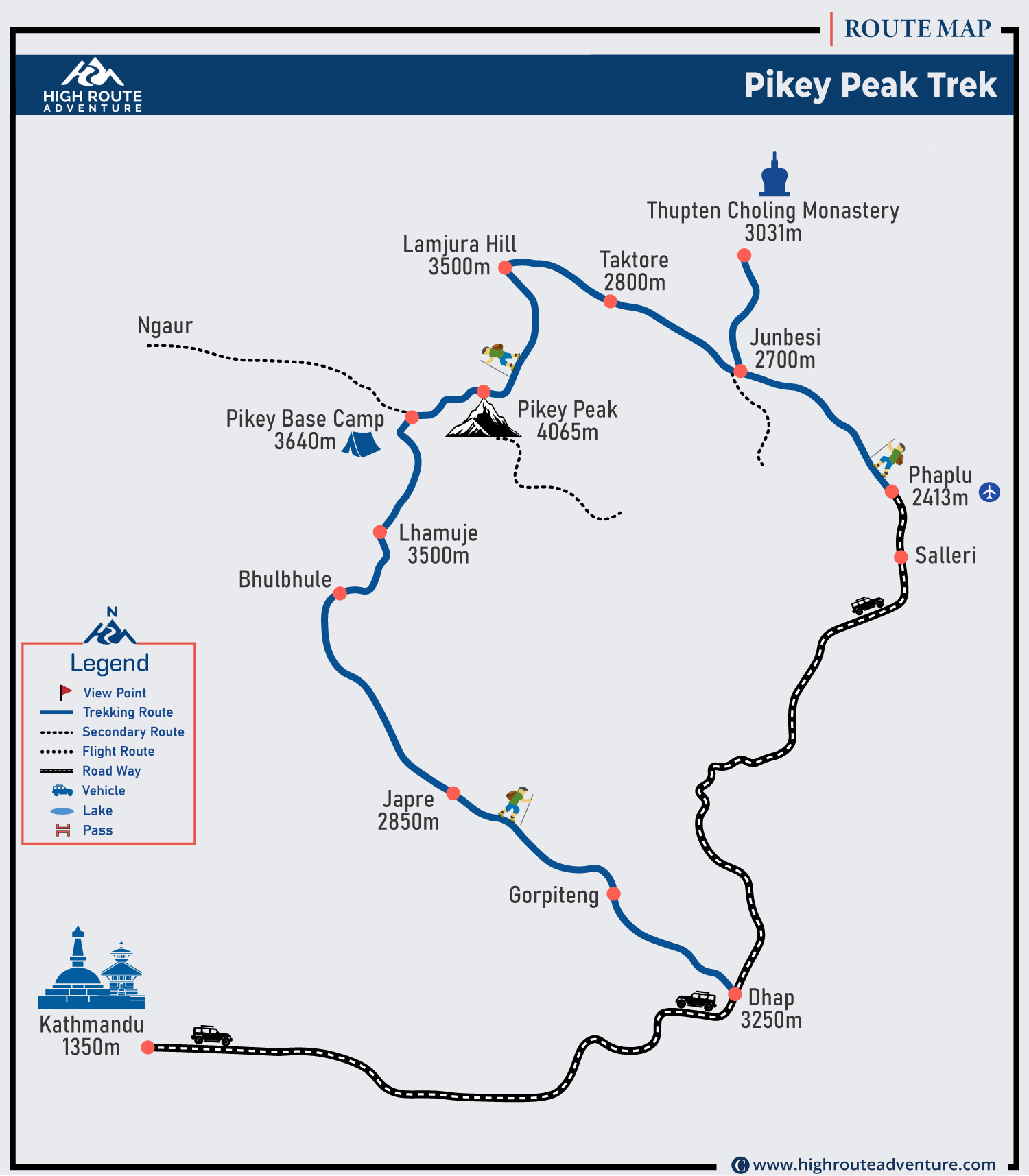
To make your road trip smooth and comfortable, High Route Adventure will arrange a 4*4 Jeep for you. There will be around 7 seats in the Jeep. The road distance from Kathmandu to Phaplu( starting point of trek) is around 250 to 270 km, and takes 8-10 hours depending on recent road conditions. Similarly, while returning after ending your trek, you will take a Jeep from Dhap to Kathmandu. The road distance from Dhap to Kathmandu is approximately 230 km to 250 km, which takes around 7-9 hours.
How to Prevent Altitude Sickness on Pikey Peak Trek
Although the risk of altitude sickness is low, we still need to be very careful about acute mountain sickness(AMS) before heading to Pikey Peak. The early symptoms of AMS are headache, dizziness, fatigue, nausea, and loss of appetite. These are the mild symptoms of AMS which can be cured by taking rest and avoiding further ascend. These AMS symptoms occur due to a lack of acclimatization and ascending too fast in high altitude, where the oxygen level is very low. If we neglect these early AMS symptoms, then it can lead to HACE and HAPE, which are deadly forms of AMS. So to prevent occurring AMS, here are the important tips you can follow:
- Ascend slowly and at your own pace to a high altitude
- Drink water and fluid items to remain hydrated all the time.
- Follow the climb high, sleep low acclimatization plan.
- Monitor your health conditions and oxygen level at high altitude.
- Eat nutritious food and try to avoid heavy meals at high altitudes
- Avoid alcohol and smoking
- Take Diamox, by consulting with the Doctor.
What to do if you catch altitude sickness during the trek:
- Don’t be to0 much nervous about AMS as it can happen to anyone.
- If you experience mild AMS symptoms, take a rest and drink fluid, hot soup and stop ascending.
- Ascend only if symptoms are cured.
- Descend to lower altitude if symptoms persist or worsen, descend to a lower altitude immediately.
- Seek helicopter evacuation in case of difficulty breathing, confusion, loss of coordination, inability to walk properly, persistent vomiting, or if your condition continues to worsen.
- Inform your guide immediately, as they are trained to handle AMS symptoms and will know exactly what steps to take in this situation.
Wifi and Communication on Pikey Peak
Mobile data (NCell/NTC) is available at lower elevations. At higher altitude NTC SIM has better coverage, at high altitude so we highly recommend that you carry NTC SIM. You can buy an NTC SIM from the airport or at an authorized shop in the city area before heading for the trip. You can use the SIM for communication as well as for the mobile internet.
Wifi is available in almost all teahouses, but it is not fully guaranteed, especially at high altitude villages. The Wifi network is slow, unreliable and expensive at high altitude.
Travel Insurance: why it's important
Trekking to Pikey Peak is safe, but we never know what situation will arise during the trek. So, prepare for the emergency situation, having travel and health insurance that covers the cost and provides support in case of medical issues, accidents, or emergency evacuation.
High Route adventure doesn't sell insurance, but we have a recommended list of trusted insurance providers that cover high-altitude trekking and helicopter evacuation. If you need insurance from Nepal, we can assist you in purchasing it.
While purchasing insurance, make sure it covers these things:
- High altitude risk up to 5,000 metres
- Emergency helicopter evacuation from remote mountain areas
- Medical treatment and hospitalization expenses in Nepal
- Accident and injury coverage during trekking activities
- Trip cancellation and interruption protection
- Loss or damage of trekking baggage and gear
- Emergency medical repatriation to your home country if required
- 24/7 emergency assistance support for immediate help in remote areas