Starting from
per person (in USD)
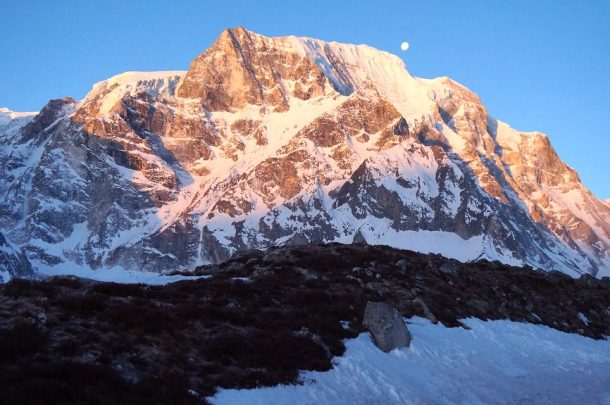
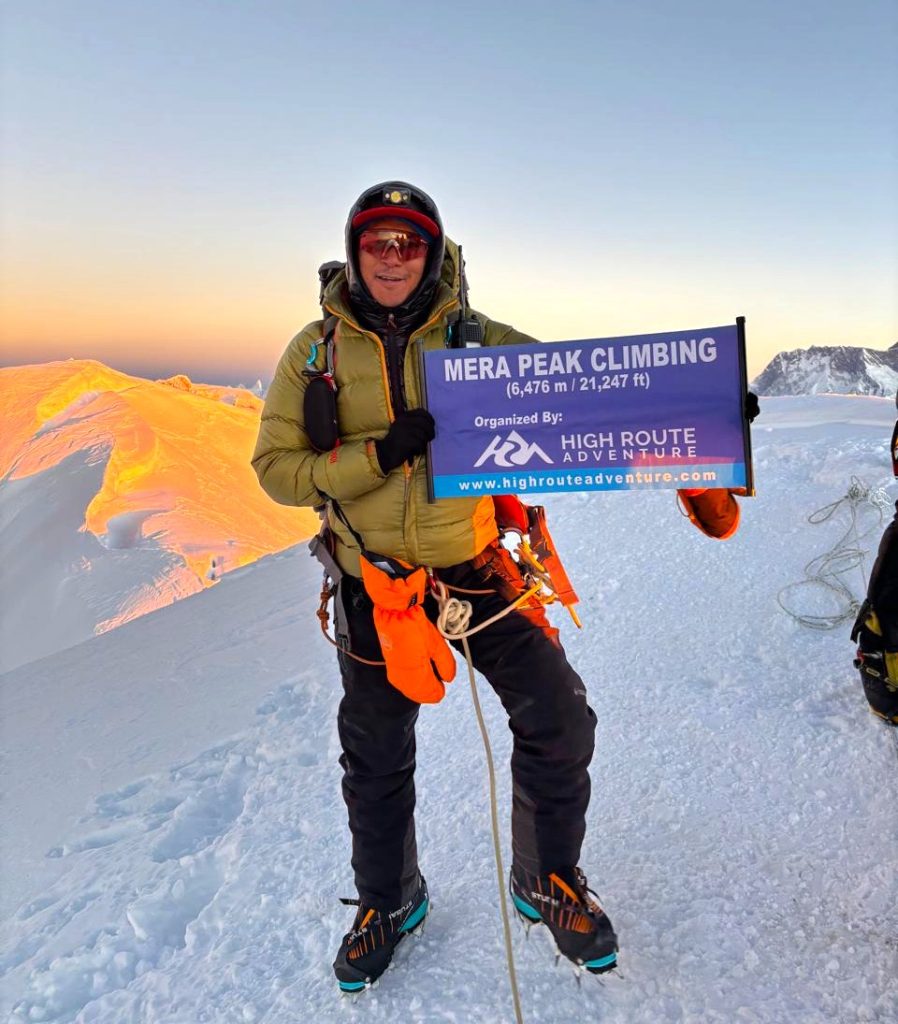
Short Mera Peak climbing in Nepal is a high-altitude adventure that takes you to a maximum elevation of 6,476 meters at the summit. Mera Peak is located just 20 kilometres southeast of the Everest massif and is located within the Mahalangur Himalaya. From the top of the Mera Peak summit, climbers are rewarded with a panoramic view of Mount Everest, Lhotse, Cho Oyu, Makalu, and Mount Kanchenjunga.
Mera Peak is a famous trekking peak in Nepal among climbers because it does not require any previous high-altitude mountaineering experience.
This 13-day short Mera Peak Summit itinerary follows the standard Hinku Valley route via Khare, leading to the summit through the southeast ridge.
Your climbing adventure begins with a scenic flight to Tenzing Hillary Airport at Lukla. From Lukla, you trek through lush hills, a Sherpa village, a thrilling suspension bridge, and cross Zatrwa La Pass(4,600 m / 15,092 ft).
After basic mountaineering training at Khare, you will gradually push for the summit through Mera Peak Base Camp and High Camp.
From river gorges and high alpine pastures to glacial moraines and crevassed ice fields, the journey offers ever-changing Himalayan landscapes. Climbing to Mera, you will witness golden sunrises, pristine mountain lakes, and spectacular views of the Mera Glacier and Mera La (Mera Pass) ice section.
The route also passes through traditional villages rich in Buddhist culture, adding a spiritual and cultural depth to this extraordinary Mera Peak expedition. In the Khumbu Region, among Island Peak, Lobuche East, and Mera Peak, is the easiest and most beginner-friendly.
If you want to experience this extraordinary 6,000-meter peak in 2026, book the Mera Peak Package with us and get a special discount.
When you stand at the top of Mera Peak on a clear day, you can get the best panoramic view of the Five 8,000-Metre Giants:
1. Mount Everest (8,849 m) — Northwest
2. Lhotse (8,516 m) — Northwest, beside Everest
3. Makalu (8,485 m) — Northeast
4. Kangchenjunga (8,586 m) — Far East
Along with this other notable mountain peak, Ama Dablam, Baruntse, Thamserku, Island Peak, and neighbouring snow-capped peaks are really impressive to watch.
Below the summit point, you can see the Mera Glacier spreads out as a huge field of ice with deep cracks and snow. The glacier looks ancient, with blue and white ice, and from this height, it gives a strong feeling of how high you are in the mountains.
Also, the distant view of Hinku Valley looks thousands of meters lower, and to the south and east, you can see the wide ridgelines of Makalu Barun National Park.
If you are an expert climber, you can combine Island Peak with Mera Peak. For detailed info, check this package – Mera & Island Peak Climbing via Amphu Labtsa Pass.
We are a local tour operator located at the heart of Kathmandu and officially certified by the Nepal Tourism Board(NTB) and Nepal Mountaineering Association(NMA). We provide licensed local Sherpa guides to you on a 1: 2 ratio who are trained, know first aid, and know how to handle emergencies.
Before starting, we provide a safety briefing to every climber as well as basic mountaineering training in the field from our guide. To make your trip smooth and safe, we also provide other supportive staff( porter, cook and other necessary staff).
Our short Mera Peak Cost is budget-friendly, and the itinerary is flexible. There is no hidden price as everything is listed in our package. While joining with us, our expert team will safely navigate you to the top of the summit. Each climber will get personalized care and support throughout the journey. To date, 2026, we have completed over a hundred successful attempts with travellers around the world.
To make your journey easier, we provide a duffel bag, sleeping bag, and down jacket. After a successful ascent of the summit, we also present you with a certificate of achievement as a memorable recognition of your accomplishment.
If you have any queries regarding the trip, contact our expert tour operator through
Phone/Whatsapp(+977-9851058664). We are always ready to assist you with detailed guidance and quick responses.
Check out other popular packages in the Khumbu region: Ama Dablam, Everest Base Camp Trek, Three Passes Trek, Gokyo Lake, and many more.
Our 13-Day Budget Mera Peak Climbing Package starts from USD 1,985. If you are in a group, High Route Adventure provides a special discount to you. The more you are in a group, the more discounts you can get on a package. We also offer a private and customization package to meet your requirements.
| No. of People | Cost |
| 1 – 1 | USD 2,380 per person |
| 2 – 5 | USD 2,195 per person |
| 5 – 8 | USD 1,985 per person |
Note: If you are above the group of 8, for the price, contact our tour operator for the special rate.
Wake up early in the morning for the Lukla flight. After breakfast, our guide will transfer you from your hotel to the domestic terminal. 35 minutes of a short and scenic flight takes you to Lukla airport. Start trekking from Lukla through terraced villages and dense rhododendron forests to reach Chutanga.
Note: If your Lukla flight is from Manthali Airport, we need to reach the Thamel bus station and the bus leaves at 2 AM.
Today, we will cross the challenging Zatrwa La (4,600m/15,092ft) to enter the Hinku Valley. The ascent through dense forests of juniper and fir takes you to open ridgelines with sudden panoramic views. From Zatrwa La Pass, a wide view of a beautiful glacier-carved valley beside the famous Khumbu region starts to appear. Also, a glimpse of Kongde Ri, Karyolung, and Number Himal is stunning to watch from here.
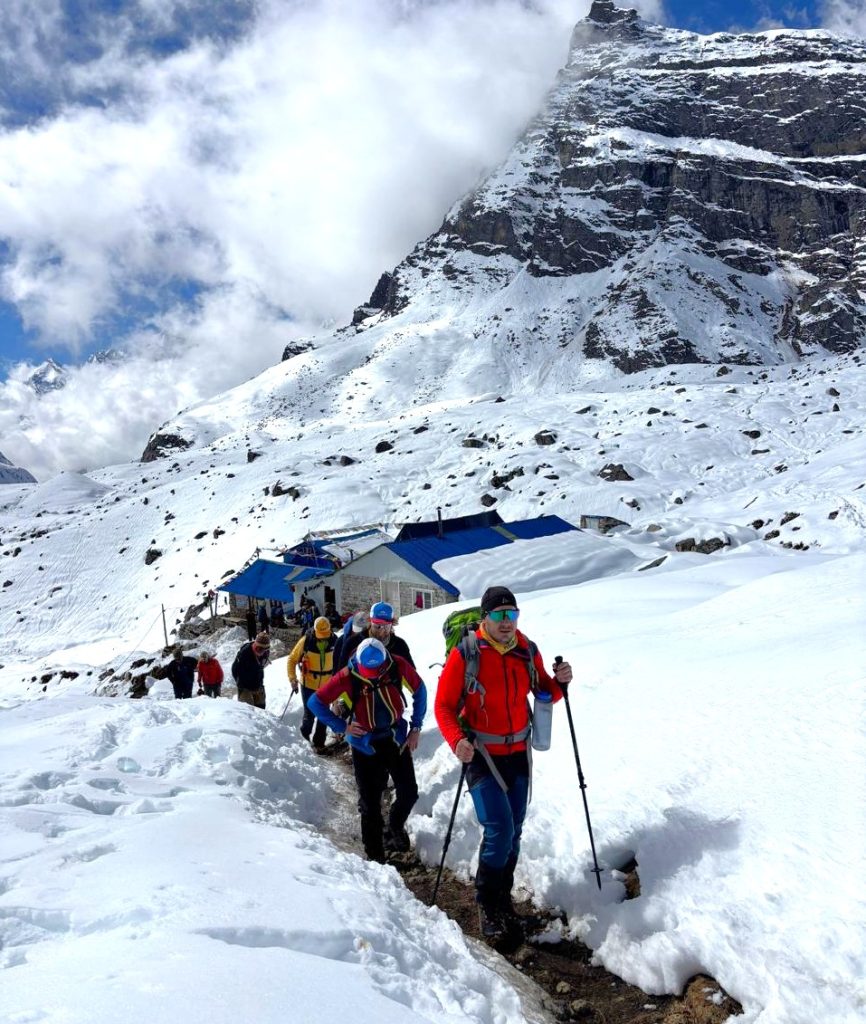
After a long descent from the Thuli Kharka, you will reach the lush Hinku Hola river valley. The trail passes through Sanu Gaun, Pangkongma, and Gonglha before reaching the riverside settlement of Kothe at 3,691 m. Kothe is located where the Hinku River turns sharply to the north. From here you will experience no roads, no motors, just glaciers, mountains and sky. While walking through the forest, keep your eye on Himalayan monal pheasants and langur monkeys. Once you reach Kothe, you can see Kusum Kanguru on the eastern side, and Mera Peak becomes visible further up the valley.
Today, you will gain rapid altitude, so instead of a long walk, today will be a short and steady altitude push. Following the trail of the glacial Hinku River upstream, it leads to Gondishung, which features mani walls and an ancient gompa (Buddhist monastery) dating back centuries. The landscape turns from dense forest to open moraine and rocky terrain as you approach Thaknak. As soon as you arrive at Thaknak, you are welcomed by mountain views. You can see Mera Peak in the north, along with Charpate Himal (6,100 m) and Sabai Tsho glacial lake further up the valley.
Following the steady trail, the Hinku valley turns into a narrow and glacial path. On the way, you will see Sabai Tsho, a beautiful glacial lake with bright green water reflecting the ice and rocky mountains above. As you continue, the end of the Mera Glacier comes into view as you reach Khare, the last permanent settlement before the higher camps. From Khare (5,045 m), you can see Mera Peak (6,476 m) and the upper Mera Glacier, with the route toward Mera La (5,415 m) leading into the glacier slopes. It is the main base for the Mera Climb, where trekkers learn basic mountaineering skills before the summit push.
Today is a crucial rest day to acclimatize your body to high altitude. In the morning, you will hike to the glacier to learn glacier skills. Your certified Sherpa guides give you training on how to use the crampon fitting, ice axe technique, rope management, and rope travel on moderate slopes. These glacier skills will help you stay safe and confident during the summit climb.
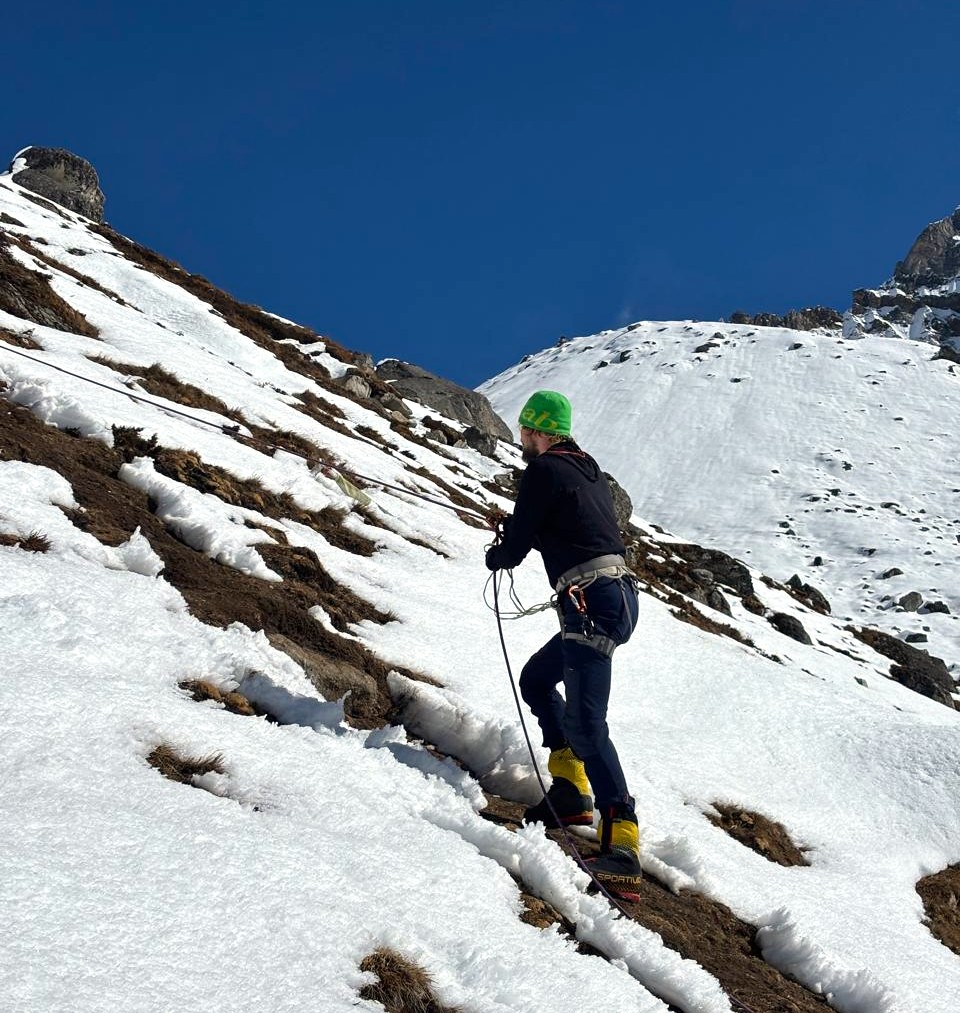
From Khare, the trail climbs over rocky and snowy terrain until it reaches the Mera Glacier. Once on the glacier, climbers put on crampons to walk safely on the ice and avoid slipping.
The route continues across Mera La (5,415 m) and then ascends the broad Mera Glacier to High Camp (5,780 m). This glacier walk is steady and spectacular, like a vast white highway surrounded by some of the world's highest peaks.
High Camp is set on the upper snowfield of the glacier. From here, the mountain views are stunning, and on clear evenings, several 8,000-meter peaks can be seen.
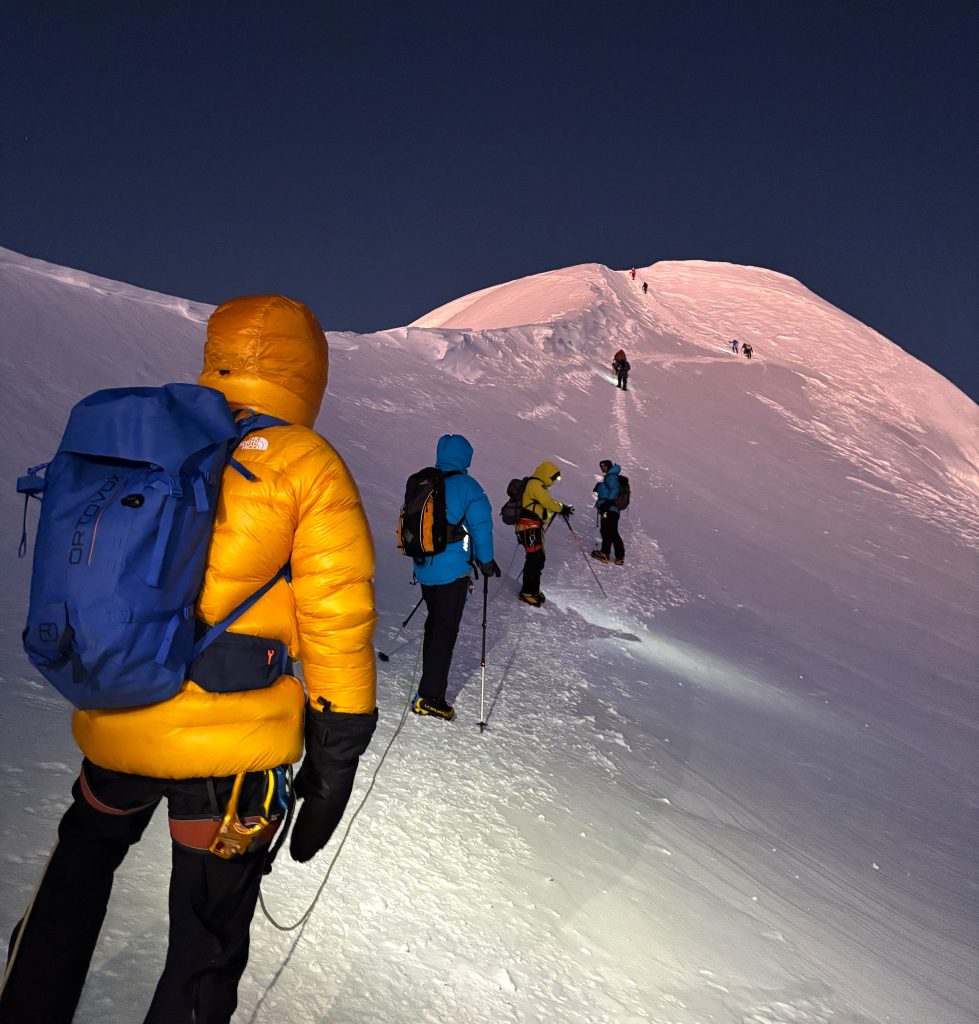
Once the alarm hits, we wake up and get ready for the summit by putting on the headlamp in the dark. From High Camp, the climb begins on the rocky moraine before stepping onto the Mera Glacier. The initial ascent is moderate, with a steady snow slope as climbers move upward in rope teams.
As the route continues toward the upper glacier, the terrain becomes steeper and more demanding due to thin air and freezing temperatures. Climbers carefully navigate crevasses while maintaining a steady pace.
The final section leads to the summit ridge, where the slope becomes steeper, and fixed ropes are used for safety. From here, the route continues to the Central Summit of Mera Peak (6,461 m).
The summit offers a breathtaking 360-degree panorama of the Himalayas, including Mount Everest (8,848 m), Lhotse (8,516 m), Makalu (8,485 m), Cho Oyu (8,188 m), and Kangchenjunga (8,586 m), along with other peaks like Baruntse (7,129 m) and Chamlang (7,319 m).
After spending time at the summit, head back to the Khare, navigating safely.
Himalayan weather is famously unpredictable. We have kept this full day in reserve for weather delays, summit re-attempts, or simple recovery after the summit push. If everything goes as per plan, you can even skip this day.
Begin your long descent by heading downstream along the Hinku Khola (river). From a high altitude landscape, you will return to the forest with ease in breath due to altitude loss. You will stop in Lungsumgba Gompa once again. Behind you, Mera Peak stands in the distance, while Kusum Kanguru rises along the eastern ridge.
You will follow the same route on your return journey. The trail climbs back toward Thuli Kharka, passing through Sanu Gaun and forested paths. Thuli Kharka has open meadows with yak grazing grounds, where you can spend a peaceful night.
For the final time, you will cross the mountain pass - Zatrwa La Pass(4,600 m). From the pass, enjoying the view of Kusum Kanguru, Numbur Himal, Hinku valley, and Mera range, you will descend to Lukla following the Dudh Koshi River.
An early morning flight from Lukla takes you to Kathmandu. Before getting to the airport for the flight, you will say farewell to your guide and porter. Then, enjoying the aerial view of Everest, Lhotse, Makalu, and Mera Peak from above, you will land at Kathmandu airport. From the airport, you will be transferred to your hotel.
To book the Mera Peak Climbing Package with High Route Adventure, you can do online booking through our website. You can visit the package and click on the book now option, fill in the required information, and make a payment of 20% of the total trip cost. Once we receive the payment, we will send you the booking confirmation through email or whatsapp.
For the payment, you can choose any of these suitable options:
Cancellation: To read in detail about the cancellation policy, check our terms and conditions.
Mera Peak climbing difficulty is graded as non-technical (Alpine Grade PD) as per the French Alpine measurement system. The factors that add challenge are extreme altitude, sudden weather shifts, low oxygen levels at high altitude, and physical and mental demand.
The route to Mera summit is straightforward, which consists of glacier travel, gradual snow slopes, and moderate alpine terrain. Although no previous mountaineering experience is required, you need to learn how to use basic climbing skills.
The most challenging part of this journey is the challenge posed by extreme altitude during non-stop climbing on the summit push. The freezing temperature, high wind, altitude exposure, physically demanding, and risk of altitude sickness make this trip tough. However, with pre-preparation before heading for the trip, the challenge can be reduced. Around 80-90% climbers have successfully reached the top of the summit when they prepared physically, mentally and followed proper acclimatisation.
Read more: How Difficult is Mera Peak Climbing?
To reduce the challenge during the journey, climbers should focus on building endurance. We recommend climbers to do fitness training at least 3 months in advance. Every day, give 1-2 hours to do activities such as hiking, running, cycling, stair climbing, and strength training.
During the trek + climb journey, you should be able to walk for 6-7 hours on average by carrying a 7-8 kg day backpack. So your leg should be strong enough to handle long trekking hours.
When you are physically fit, you can perform better at high altitude. Along with physical preparation, you should be prepared mentally when the days are tough. There will be challenging days when you need to deal with the discomfort of thin air, freezing temperature and basic facilities on the trail. This can be eliminated with a positive mindset and strong determination to reach your goal.
Here are the acclimatisation tips you can follow:
Worth reading: How To Prevent Altitude Sickness On Mera Peak Climbing?
On this 13-day journey of short Mera Peak climbing, you will stay in the teahouse most of the time. This teahouse is located on the trekking trails, and rooms are booked inside the teahouse by us. Travellers can expect basic facilities while staying in the teahouse. Inside the room, you will get twin sharing beds, a warm blanket and a pillow. There will be no heating system or AC. Wifi and charging for electronics are available in most of the places, while hot showers are very limited. You need to pay certain fees to use this facility.
Three meals per day will be arranged by us throughout the trekking and climbing journey. You can expect veg and non-veg items. Food is mostly Nepali dishes with very few options of International dishes.
There will be a communal dining hall where trekkers will gather to eat their food. Let’s see the type of meal you can expect in a teahouse:
You can find a variety of drinks, snack items, bakery products, and light refreshments, but these things are not included in the package. However, these items are not included in the package cost. You need to pay separately for this.
Budget this amount for the teahouse:
To participate in the Rapid Mera Peak Expedition with High Route Adventure, it is important to submit your travel insurance. While purchasing the travel insurance, it should cover these things:
Note: For the 2-week journey, you need to budget around USD 240-300 for the insurance package. If you need any assistance in choosing suitable insurance, our team can help guide you. Further reading: Travel Insurance for Trekking and Peak Climbing in Nepal
High Route Adventure will arrange the flight ticket for you to Tenzing Hillary Airport, Lukla. However, if you need to reach Manthali airport for the flight, we will arrange the transportation for you. The road drive from Kathmandu to Ramechhap Manthali airport is around 4-5 hours.
Lukla flight cancellation is common due to weather dependent. If your flight is canceled for several days, you can take a helicopter flight by paying an additional cost of USD 550- 650 per person on a sharing basis.
The best time for the Mera Peak Climbing is in spring- March to early May. The climbing season begins from March due to stable weather, clear visibility and favorable conditions for summit push. Another popular time for trekking Mera Peak is during the months of autumn, October to November. During this period, clear sky with perfect visibility, with good mountain views, minimal chance of rainfall make it the best alternative to spring.
In case of bad weather during the summit, we have kept consistent days in the Mera Peak trek itinerary. This will help to adjust the schedule for unseen weather conditions and increase the chances of a safe and successful summit attempt. Continue reading: Best Time to Climb Mera Peak
For this short Mera Peak Climbing you will need:
| Permit Type | Season | Cost (USD) |
| Mera Peak Climbing Permit | Spring (March–May) | $350 |
| Mera Peak Climbing Permit | Autumn (Sept–Nov) | $175 |
| Mera Peak Climbing Permit | Winter (Dec–Feb) | $175 |
| Mera Peak Climbing Permit | Summer/Monsoon (Jun–Aug) | $175 |
| Additional Permit | Cost (USD) | Issuing Authority |
| Makalu Barun National Park Entry Permit | NPR 3,000( approx 25 USD) | Nepal Tourism Board |
| Sagarmatha National Park Permit | NPR 3,000( approx 25 USD) | Nepal Tourism Board |
Note: All this permits will be arranged by High Route Adventure you need to submit your passport scanned copy and pp-size photo.
Here is your full packing list for Mera Peak Climbing.
Starting from
per person (in USD)