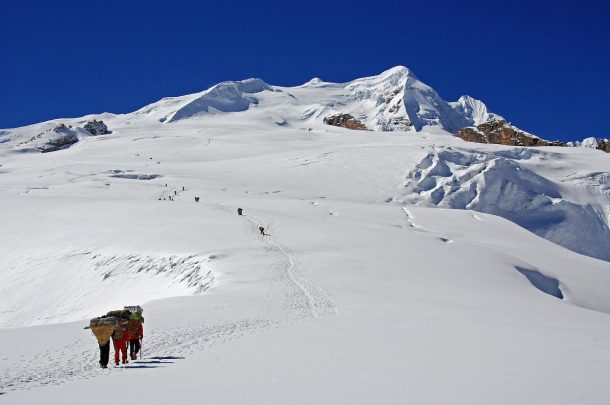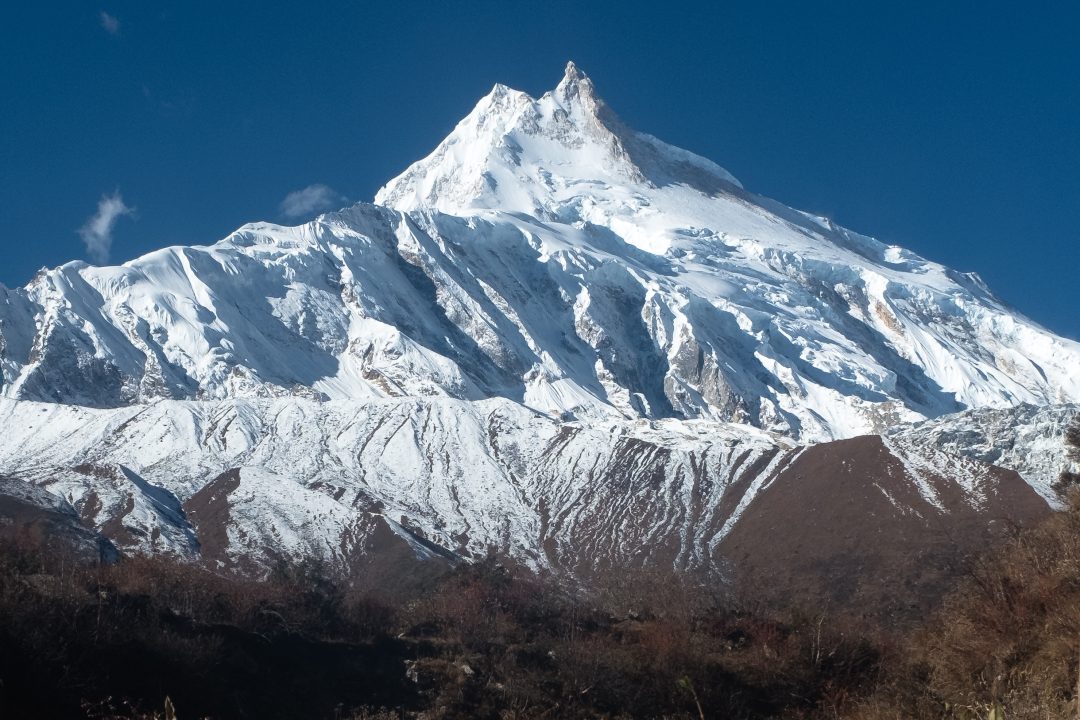
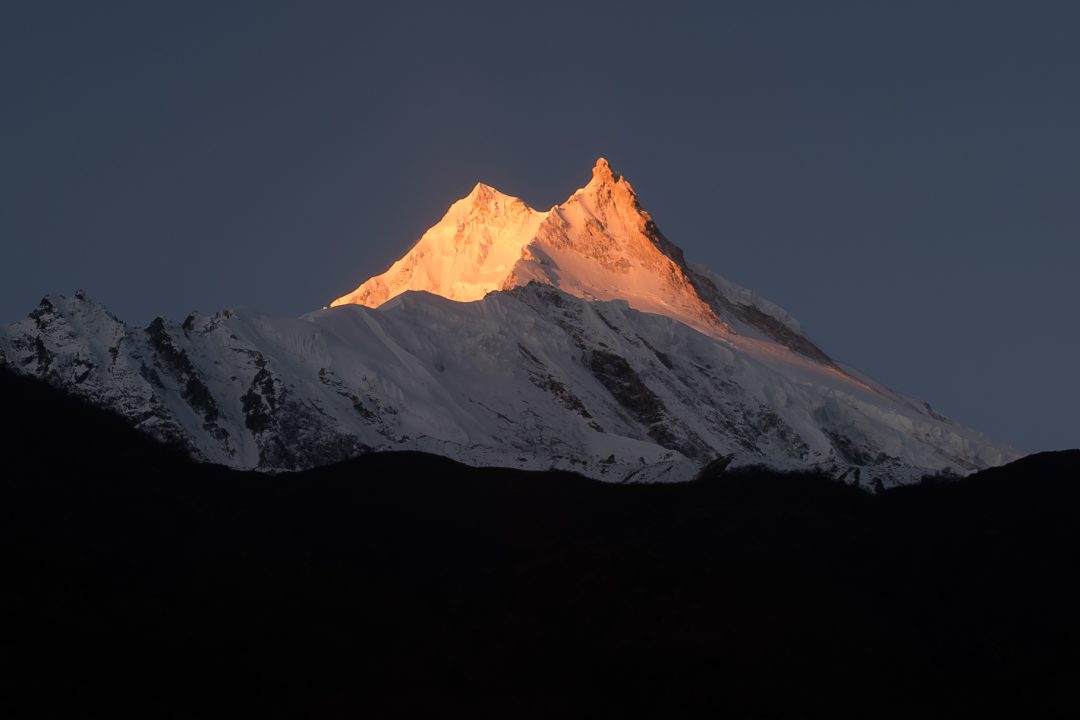
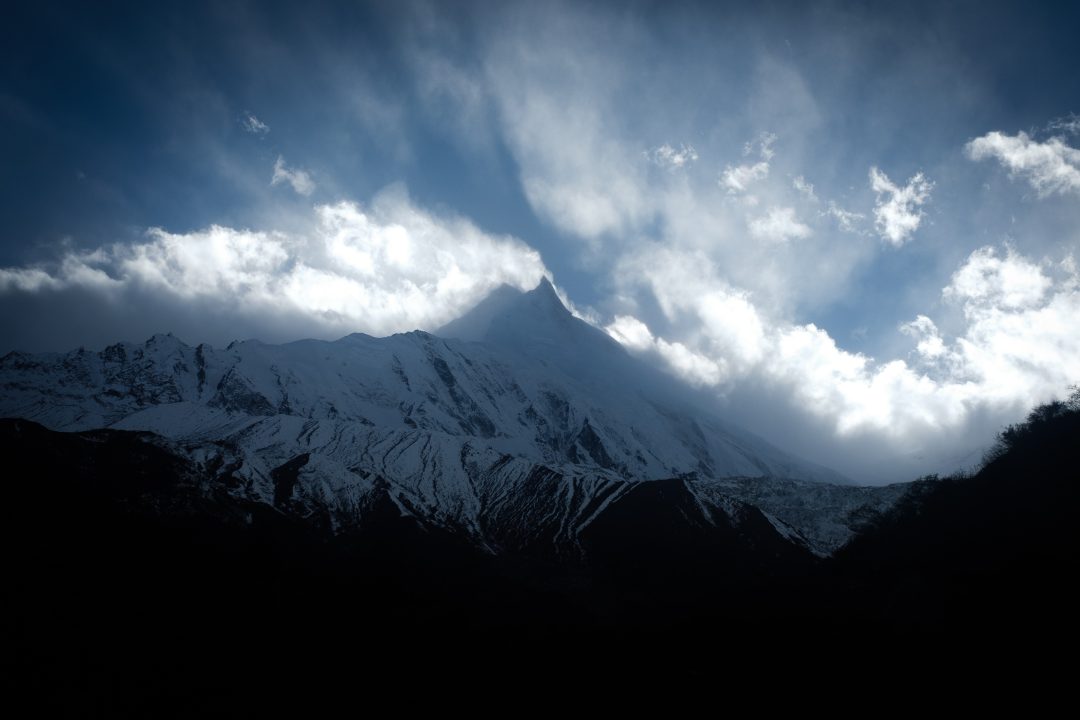

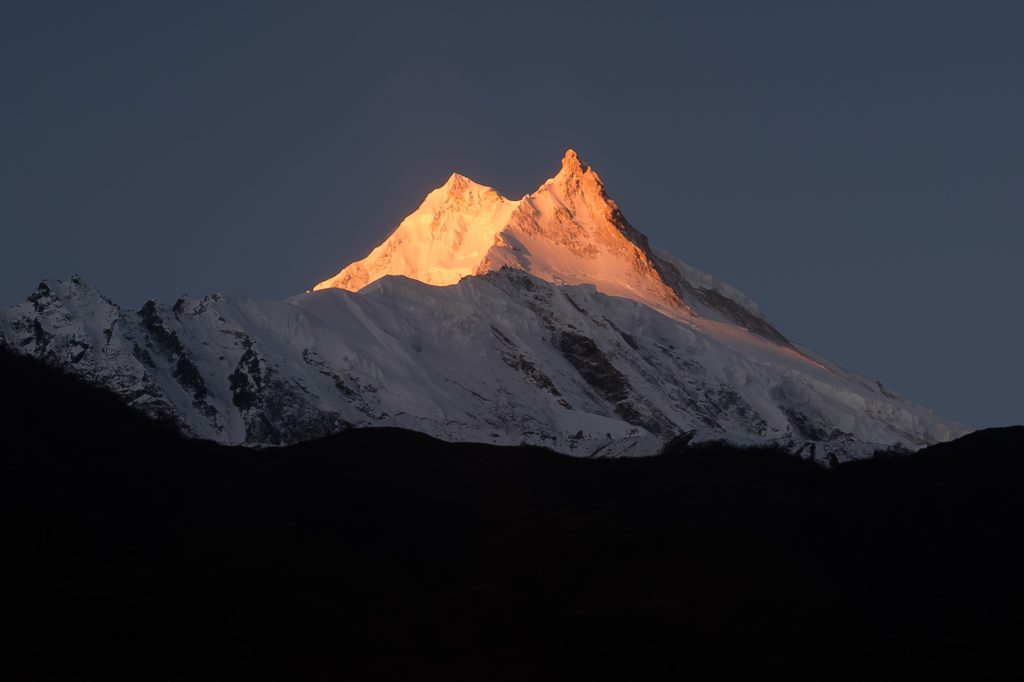
Rising to 8,163 meters (26,781ft) in the Mansiri Himal range of Nepal’s Gorkha District, Mount Manaslu is the eighth-highest peak in the world. Known in Sanskrit as Manasa (“Intellect” or “Soul”), this mighty giant offers one of the most accessible yet rewarding challenges in the Himalayas. Since the historic first ascent by Toshio Imanishi and Gyalzen Norbu in 1956, the Manaslu Expedition has evolved into the premier training ground for mountaineers aiming for the top of the world.
Often regarded as the most achievable of the 8,000-meter peaks, Manaslu is the logical next step for climbers moving beyond 7,000 meters. Unlike the technical challenging peaks like K2 or Annapurna, the Manaslu climbing route (via the Northeast Face) is direct and well-established. This lets you work on your endurance at high altitudes rather than on your ability to perform complicated technical moves. It’s the perfect “final exam” before you try to climb Mount Everest or Cho Oyu.
While other operators focus on numbers, we focus on planning and preparation. Our 34-day Manaslu expedition itinerary is meticulously designed to maximize acclimatization and safety.
The Manaslu expedition journey begins long before the crampons go on. The trek to Manaslu Base Camp (4,800m) goes through the restricted Nubri Valley. Here you can explore a hidden gem of Tibetan culture that remains far less commercialized than the Everest region. The Manaslu peak trail goes through the humid subtropical forests of Arughat and the stark, wind-swept beauty of Samagaun.
Join us for the Autumn 2026 season and discover why Mt. Manaslu is the true “Mountain of the Spirit”.
| Mountain Name | Mount Manaslu (Kutang) |
| Elevation | 8.163m (26,781ft) |
| Global Ranking | 8th Highest Mountain in the World |
| Location | Gorkha District, Mansiri Himal, Nepal |
| Difficulty Grade | 4E (Advanced/Very Strenuous) |
| Best Season | Autumn (September – October) |
| Standard Route | Northeast Face (Normal Route) |
| Duration | 35 – 45 Days (Kathmandu to Kathmandu) |
| Base Camp Elevation | 4,800m (15,748ft) |
| First Ascent | May 1956 (Toshio Imanishi & Gyalzen Norbu) |
| Climbing Permits | Required (Manaslu Expedition & Restricted Area Permit) |
| Nearest Airport | Tribhuvan International Airport (KTM) |
| Success Rate | High (~85% in Autumn Season) |
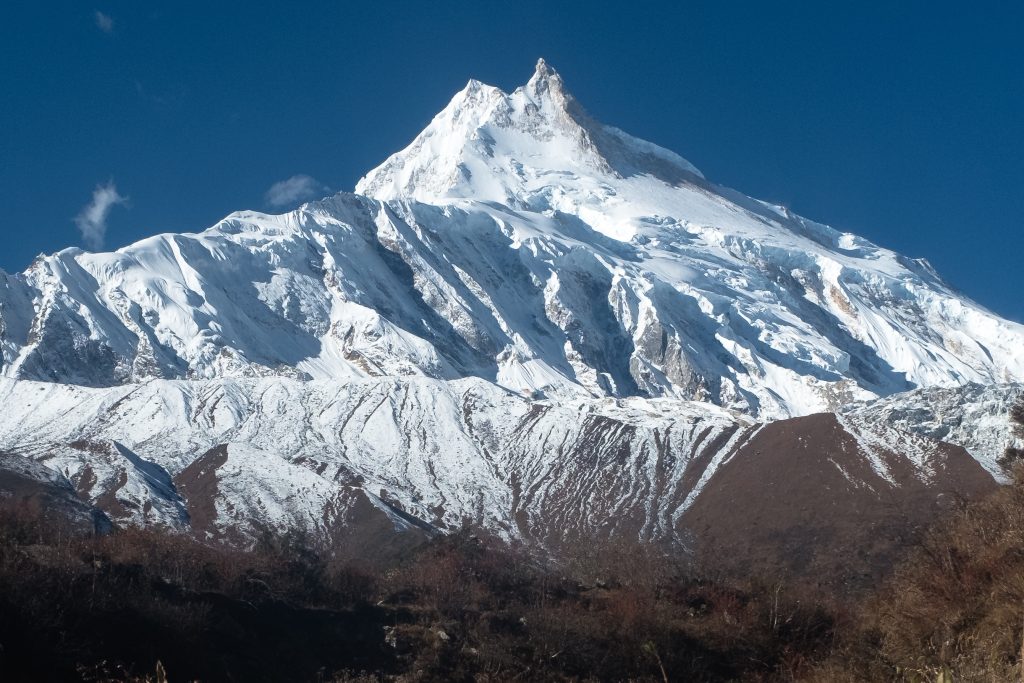
If you’re looking to break into the “8,000m Club,” Manaslu isn’t just a good option- it is arguably the only logical place to start. Here is why we recommend it over Cho Oyu or Everest for your first big expedition.
A Note on “Crowds” You might read that Manaslu is “empty”. In Autumn, that’s not entirely true anymore- it’s popular because it’s achievable. However, compared to the chaos of the Hillary Step on Everest, Manaslu still feels like a climber’s mountain. The campsites are cleaner, the vibe is more relaxed, and the pressure is lower.
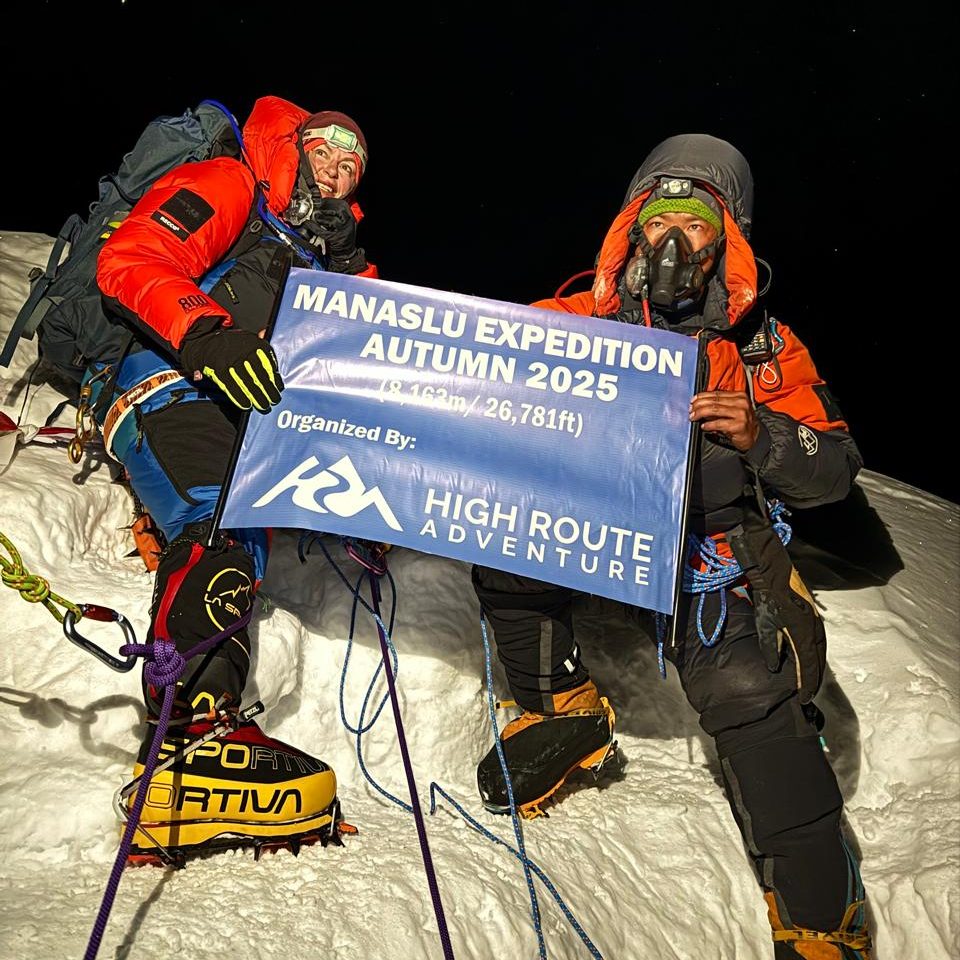
There are dozens of operators in Kathmandu. Why trust us with your life on an 8,000-meter peak:
1. We Are the Locals High Route Adventure is not a foreign company with a flashy website and disconnected office. We are 100% Nepali-owned and operated. The Sherpas guiding you up the Manaslu Headwall are the same who designed your Manaslu climbing itinerary. We know every crevasse, every teahouse owner, and every shortcut because this is our backyard.
2. No “Hidden Cost” Surprises We hate hidden fees as much as you do. Some budget operators will quote you a low price ($9000) and then hit you with bills for “extra oxygen”, “summit bonuses”, or “garbage deposits” once you arrive. Our quote is the real price. When we say the Manaslu package includes permits, food, and tents, we mean it. The only thing you worry about is climbing; we handle the wallet.
3. Small Groups, Big Attention You’ve seen the photos of “traffic jams” on big mountains. That happens when massive commercial agencies run groups of 50+ people. We don’t do that. We keep our teams small and agile. This means:
4. Base Camp is Your Sanctuary. Climbing Manaslu peak is brutal; recovering shouldn’t be. We invest heavily in our Base Camp setup because we know that morale matters. We use high-quality, wind-resistant dining tents, provide unlimited hot drinks, and our kitchen crew works miracles with fresh ingredients. If you’re happy and fed, you climb better.
5. Safety Over Summits We want you to summit, but we need you to come back. Our guides are authorized to turn a group around if the weather changes or there is a high risk of avalanche – even if the summit is right there. We carry satellite phones, comprehensive medical kits, and backup oxygen for every team. We have a 100% safety record because we know when to say “no”.
The Mountain of the Spirit Manaslu (8,163m) is often called the “Japanese Mountain,” in the same way Everest is called the “British Mountain” and Nanga Parbat is called the “German Mountain.” While today it is known as a popular commercial peak, its history is a bit controversial and deeply spiritual.
Located in Gorkha District, it is named after the Sanskrit word Mansa (“Intellect” or “Soul”). But for the locals of Samagaun, it is the dwelling place of the gods- a belief that led to one of the most intense conflicts in Himalayan history.
The first attempts to climb Manaslu weren’t stopped by ice, but by the people.
Once the route was opened, the world’s best climbers came to test the limits of human endurance.
| Year | The Feat | The Details |
| 1972 | The Tragedy | Reinhold Messner’s team attempted the South Face. It ended in disaster when two climbers died in a storm, changing Messner’s approach to climbing forever. |
| 1974 | Women’s First | A Japanese all-female team became the first women to summit an 8,000er. A massive moment for equality in alpinism. |
| 1984 | Winter Conquest | The Polish legends Maciej Berbeka and Ryszard Ganewski climbed Manaslu in January. Climbing an 8,000er in winter (-40°C winds) is suffering on another level. |
| 1985 | Messner’s Return | Messner returned to settle the score. He soloed the mountain without bottled oxygen- arguably one of the boldest feats in the mountain’s history. |
| 2012 | The Avalanche | A massive slide at Camp 3 killed 11 climbers. It was a wake-up call that the “Standard Route” is still deadly. |
While history is full of wild ascents on the South Face, today’s reality is simple: 99% of climbers use the Northeast Face.
This is the “Trade Route.” It is technically easier than K2 or Annapurna, but don’t underestimate it.
If you see someone attempting these, they are either world-class alpinists or crazy.
Let’s talk money. Unlike Everest (which can hit $50k+), Manaslu is relatively affordable, but the price gap between operators is confusing.
The Manaslu Cost Breakdown. Realistically, for 2026/2027, you should budget between $14,500 and $17,500 for a fully guided expedition.
What You Are Paying For (Inclusions) When you see that $15,000 price tag, here is where the money goes:
Important 2025/2026 Rule: The government has flipped the pricing structure. Autumn is now the “High Season,” and the climbing permit costs $3,000. Spring is now the cheaper option at $1,500.
The “Hidden” Costs (Don’t Forget These) The Manaslu climbing package price isn’t the final number. You need to have liquid cash ready for:
The Bottom Line: If you see a Manaslu climbing package for under $10,000 that claims to include everything- run. Usually, they cut costs on oxygen (giving you old bottles) or on Sherpa experience. On an 8,000m peak, you pay for safety.
Bureaucracy in Nepal can be complex, but as your expedition operator, we handle 90% of this for you. Your job is to train; our job is to stand in line at the Ministry of Tourism.
Below is the breakdown of the fees and documents required for the Manaslu Expedition.
This is the royalty paid to the Government of Nepal for the right to climb an 8,000-meter peak.
| Season | Duration | Royalty Fee | Notes |
| Autumn (Sep-Nov) | Expedition Period | $3,000 per person | High Season (Price increased due to high traffic) |
| Spring (Mar–May) | Expedition Period | $1,500 per person | Low Season (Cheaper because snow is dangerous) |
| Winter (Dec-Feb) | Expedition Period | $1,500 per person | Winter Expedition Rate |
| Summer (Jun-Aug) | Expedition Period | $1,500 per person | Monsoon Rate |
Since the Manaslu trail passes near the Tibetan border (from Jagat to Samdo), this special permit is mandatory.
| Season | Duration | Cost (USD) | Additional Days |
| Autumn (Sep-Nov) | First 7 days | $100 per person | $15 per additional day |
| Winter (Dec-Feb) | First 7 days | $75 per person | $10 per additional day |
| Spring (Mar-May) | First 7 days | $75 per person | $10 per additional day |
| Summer (Jun-Aug) | First 7 days | $75 per person | $10 per additional day |
These go towards maintaining the Manaslu (MCAP) and Annapurna (ACAP) conservation areas.
| Permit Type | Cost (Foreigners) | Cost (SAARC Nationals) | Validity |
| Manaslu Conservation Area Permit (MCAP) | NPR 3,000 (-$27 USD) | NPR 1,000 | Trek Duration |
| Annapurna Conservation Area Permit (ACAP) | NPR 3,000 (-$27 USD) | NPR 1,000 | Trek Duration |
| Fee Type | Cost | Notes |
| Garbage Deposit | $3,000 per team | Refundable. You get this back if you bring your trash down. |
| Liaison Officer | $2,000 per team | Salary/insurance for the government officer who stays at Base Camp. |
Important 2025 Update: Unlike Everest, where Spring is the main climbing season, Manaslu is primarily climbed in Autumn. Recognizing this, the Nepal Government has updated the royalty structure effective September 2025. Autumn is now the “High Season” for Manaslu, costing $3,000 per person, while Spring permits have been reduced to $1,500.
We handle permits, but we need you to provide the raw data. Please ensure you have the following ready 45 days before departure:
The moment you step out of Tribhuvan International Airport, the High Route Adventure team will be waiting to greet you. We'll transfer you immediately to your hotel in Thamel, a busy tourist center of Kathmandu. After resting for a while, you can now stroll through the narrow, colorful streets filled with trekking shops and cafes. We officially start the expedition with a welcome dinner at night. Enjoy traditional Nepalese food like dal bhat or momo with your climbing team and other climbers. This is your first chance to get to know them. It's a relaxed night designed to let you settle in before the work begins.
Note: If you arrive early, we can arrange a short city sightseeing tour upon request. (Please inform us in advance).
Today is dedicated to logistics. After breakfast, meet your lead guide for a comprehensive gear check. If you're missing any specialized high-altitude equipment- like an 8,000m down suit or triple boots- we go rental shopping in Thamel. In the afternoon, you'll visit our head office to attend the official Expedition Briefing and finalize your Manaslu Restricted Area, MCAP, and ACAP permits. Once the paperwork is done, the evening is yours. You can visit the Monkey Temple (Swayambhunath) for a sunset view over the valley or explore the historic Kathmandu Durbar Square. The goal today is to be fully prepared so you can leave Kathmandu with a clear mind tomorrow.
We set out early for the 8-9 hours drive to the trek's starting point. Leaving the city behind, the private jeep follows the winding Prithivi Highway along the Trishuli and Marshyangdi rivers. Today's ride is long but scenic, with the landscape transforming from the humid lowlands to the terraced hillsides of the Annapurna region. As we approach the mountains, you'll get your first glimpses of snowy peaks. We eat lunch in a nearby town and then continue to Dharapani, the gateway to the Manaslu circuit. You'll arrive in the late afternoon, just in time to stretch your legs and prepare for the first day of walking.
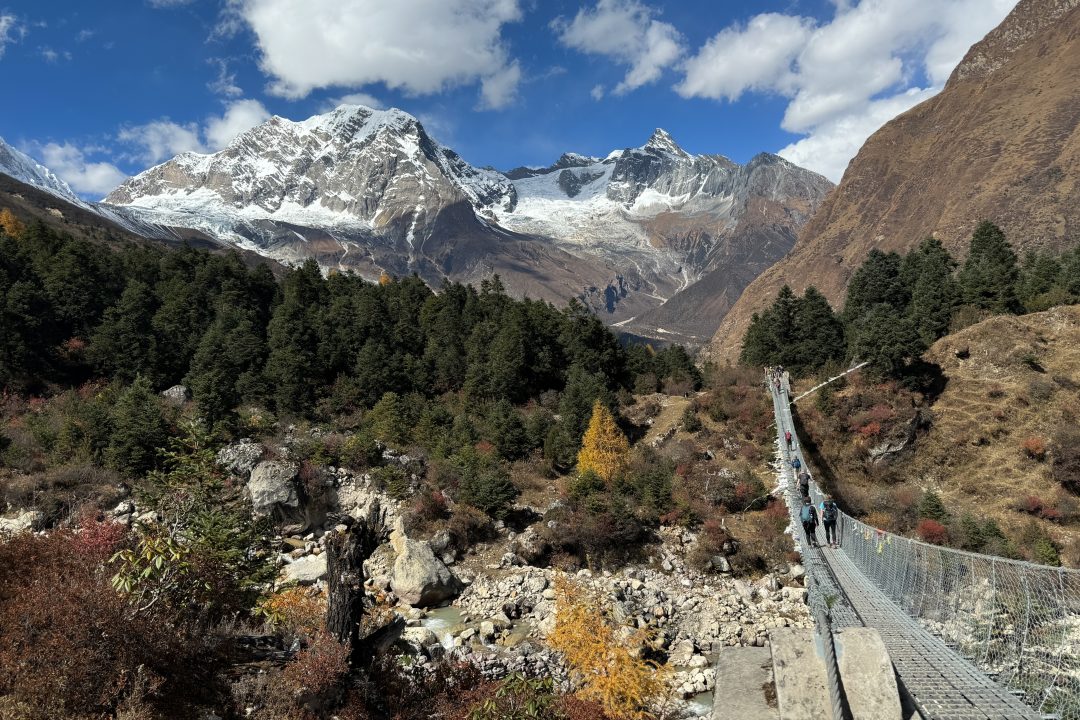
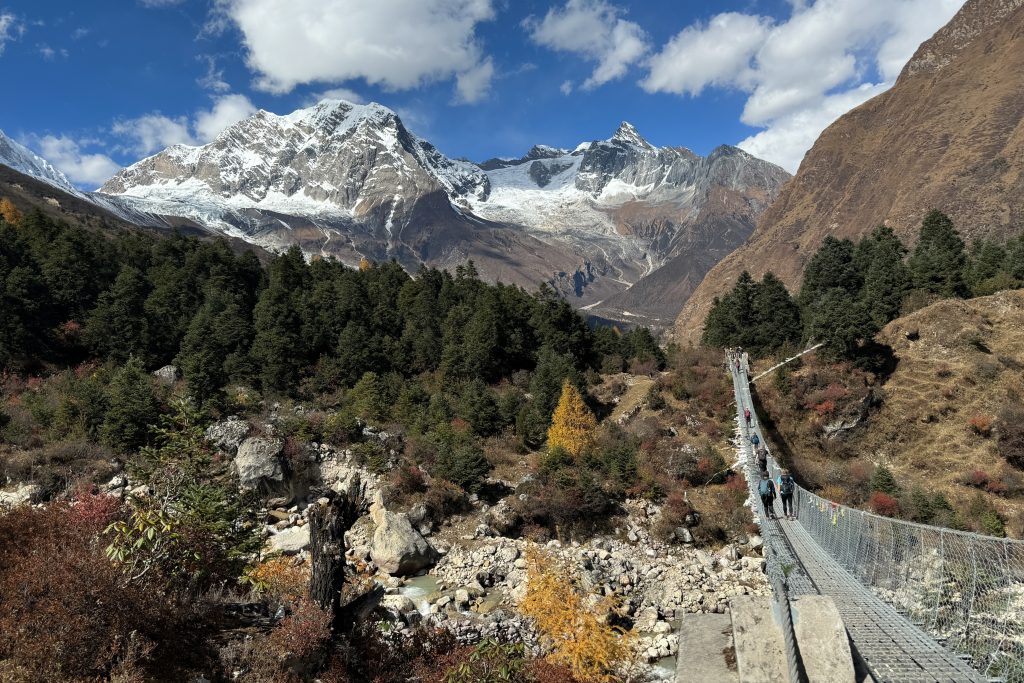
Today, we leave the road behind. The 5-6 hours trek takes us away from the main Annapurna Circuit trail and towards the hidden village of Tilije. Along the path, you'll see lush woods of pine and rhododendrons. There are suspension bridges over the Marshyangdi River that go over dramatic gorges. You'll notice the distinct shift in culture as soon as you get to Tilije. Stone-built houses and fluttering prayer flags highlight the region's strong Tibetan influence. In this small village, you'll get a beautiful introduction to the Gurung culture as well.
This is a tough day with significant elevation gain. We climb nearly 1,400 meters in 6-7 hours, going from dense forests into the open alpine zone. As we walk through Sangure Kharka, the terrain starts to get steep you cross wooden bridges over icy glacial streams. The effort pays off when you reach Bhimthang, a massive valley used as a summer yak pasture. The scenes here are abrupt and extraordinary: the North Face of Manaslu and Phungi Himal tower directly above you. As the sun sets over this natural amphitheater, look for blue sheep or marmots eating grass on the slopes.
We spend a second night in Bhimthang to let our bodies adjust to the 3,700m altitude. To stay active, we'll take a 3-4 hours acclimatization hike up to Ponkar Lake (4,100m). This "climb high, sleep low" strategy is essential for crossing the Larkya La pass tomorrow. This short-day hike lets you acclimate to the high altitude and enjoy the incredible panorama of Manaslu, Himlung Himal, and Cheo Himal at the same time. Your guide will give you a safety briefing regarding the Larkya La crossing in the afternoon. Later, you can rest and stay hydrated.
This is the toughest trekking day of the approach. We start pre-dawn to tackle the Larkya La Pass. The pass crossing takes about 8-10 hours. It is a long, steady climb over rocky moraines and snowfields. Reaching the summit of the pass (5,106m) is a massive achievement, rewarding you with eye-level views of Annapurna II, Kang Guru, and Manaslu itself. We celebrate at the summit and then start the long, steep descent walk down to the settlement of Samdo. This remote village is the last settlement before the Tibetan border and is inhabited by Tibetan refugees. You'll sleep well tonight in the comfort of a local tea house after a massive day of effort.
After the grueling pass crossing, today is a short, recovery walk. The 4-5 hours trail follows the Budhi Gandaki River down to Samagaun. Along the way, you'll pass extensive mani walls (stone tablets carved with prayers) and large yak pastures, signaling that we are in the heart of Nubri Valley culture. Samagaun is the "capital" of the Manaslu region. Sitting right at the foot of the mountain, it offers stunning, close-up views of Manaslu's East Face. Later, observe what life is like in the high-altitude hamlet by visiting the local school and the old monastery.
We take a full rest day at Samagaun to ensure everyone is healthy before moving to the Manaslu Base Camp. Rather than staying idle, we strongly recommend the acclimatization hike to Pungyen Gompa, an ancient monastery tucked into a glacial valley with direct views of the mountain. Alternatively, you can spend the day exploring the village, watching the local herd of yaks, and processing barley. This cultural connection helps ground you before we isolate ourselves on the mountain for the climbing phase.
Today, we leave the villages and walk to the Base Camp. The hike is steep and takes 4 to 5 hours to go up more than 1,200 meters. The trail goes up through the mountain, away from the trees, and into the rough, glacier-covered ground. Afterwards, you'll spot the colorful tent city of Manaslu Base Camp. This will be your home for the next few weeks. Set up your tent, meet the Sherpa climbing team, and eat your first dinner in the warm dining tent while gazing up at the massive summit towering above.
It takes time to get used to life at 4,800m. We spend the day organizing our camp and taking a short hike to a nearby ridge (5,000m) to jump-start acclimatization. The rest of the day, you can get familiar with the facilities. Check out the communications booths, meet the medical staff, and organize your gear. You'll go over the climbing route, safety protocols, and the rotation plan with your lead guide and go to sleep.
We have to participate in the traditional Puja Ceremony prior to commencing our expedition. In order to grant safe passage, a Buddhist Lama will bless the team, the climbing gear, and the mountain itself. For the Sherpas, this is a deeply spiritual moment and taking part in it strengths the bond between the climbers and the staff. The rest of the day is easygoing. While the guide tells you about the mountain's history, you can sort your high-altitude food and gear.
Today, we get technical. The Sherpa guides will lead a hands-on training session on the nearby ice slopes. You'll refresh your skills in crampon usage, self-arrest with an ice axe, and most importantly- how to pass anchors on fixed ropes using a jumar. We also do basic crevasse rescue drills and test everyone's oxygen masks and regulators to ensure they are working properly. This training ensures everyone on the team is on the same page before we step into the most dangerous sections of the mountain.
Now the real Manaslu expedition 2026 begins. We have a flexible but well-planned climbing agenda for the next sixteen days. High Route Adventure keeps the Sherpa ratio at 1:4, and for the summit, it is 1:1.
After a safe return from the summit, we pack up. Following the strict "Leave No Trace" principles, we ensure every piece of trash is removed from Base Camp. We then say goodbye to the ice and trek back down to the thick air of Samagaun. It takes 4-5 hours to go down; with every meter you drop, you'll feel your strength coming back. We celebrate that night in a comfortable lodge.
Option 1 (Standard): Most Manaslu climbers choose this standard helicopter option. It's a spectacular 1-hour heli flight from Samagaun back to Kathmandu. The heli ride soars over the route you spent weeks trekking. By afternoon, you'll be back in your hotel, enjoying a hot shower and a real bed.
Option 2 (Trek): If you prefer to walk, you can trek out via the Buri Gandaki Valley (adds 5-7 days).
The Manaslu expedition itinerary includes these extra days as insurance. If we have mountain weather, summit delays, or concerns about helicopter flights, we can use these contingency days to keep the schedule on track. If all goes as planned, then you'll have extra time to visit Kathmandu's UNESCO World Heritage Sites before your flight home.You have the opportunity to unwind in Kathmandu on your leisure day. So, you can shop for souvenirs in Thamel, visit the spa, or just relax at a rooftop cafe. We'll have one final dinner to celebrate the evening.
Fly Back to your home country
Manaslu isn't a standard vacation, so we don't book it in one click. We need to know who you are first. You can drop us a line at bookings@highrouteadventure.com (or use the form at highrouteadventure.com/inquiry) with the subject line "Manaslu Expedition Inquiry".
We need the following basic details from you:
Once we have your background, we'll build a custom package for you. Within a day, our team will provide a complete proposal that includes:
Please note that to secure your seat, you need to make a 30% deposit via Bank Transfer or PayPal.
At least 2 months before the expedition, we finalize the critical details. At this stage, we need the following information:
Before you pack your bags, you'll join a pre-expedition Zoom call with us. For one last time, we'll go over your gear and answer last-minute questions. After that, get on the plane. Our team will be waiting for you at the Kathmandu terminal.
Rescheduling: We try to be flexible if you just need to change the times. If you notify us at least 60 days in advance, we'll move you to another season at no cost. Within that 60-day window, a $1,000 rescheduling fee.
Pro Tip: Make sure your travel insurance covers "Trip Cancellation" for medical emergencies. If you become sick or injured before the trip, we'll provide all the documentation you need to file a claim.
Ready to start? Email us at info@highrouteadventure.com for booking Manaslu Expedition.
Manaslu might be known as one of the "easier" 8,000-meter peaks, but let's be clear: there is no such thing as an easy 8,000er. Some climbers may find it easier than K2 but thinking of it as an easy walk-up can be a dangerous mistake. With good reason, it is graded as 4E (very strenuous).
The altitude - the thin air - is the real killer here. At 8,163 meters, you're running on about 30% less oxygen than at sea level. Every step will feel like a marathon. Altitude sickness (AMS, HAPE, HACE) is a real risk that can get worse quickly. That's why you are not just climbing; you're living there for 6 to 8 weeks, so your body can adapt to the "death zone."
The technical difficulty is another challenging factor because it's not just hiking in the mountains. While climbing from Camp 1 to Camp 2, you'll hit steep snow and ice, so you'll need crampons and fixed ropes. Plus, you need to navigate crevasses and unstable seracs, which is a real risk no matter how fit you are. It's easier than Annapurna's vertical ice cliffs, but you still need an ice axe and rappelling skills.
There's a high risk of objective hazards and unstable weather conditions. Manaslu is famous for avalanche exposure, unstable snow, and the danger from hanging seracs. The weather is highly unpredictable, with rapid shifts to heavy snowfall, strong winds, and extreme cold that can lead to frostbite. Additionally, the weather windows for summitting can be very short.
The trekking and climbing route to Manaslu Peak is very remote. Manaslu base camp and higher camps are isolated with limited infrastructure. Climbing at this altitude requires great cardiovascular fitness, mental toughness, and experience on peaks higher than 6,000 meters and 7,000 meters. You need to maintain peak performance even after weeks of mental and physical exhaustion.
For preparation for Manaslu peak climbing, you need about 6 to 9 months of serious prep work. Cardio is king for mountain climbing. Aim for 4-6 sessions a week. Whether you run, cycle, or swim, you need to be going for 1-2 hours at a time. Don't just cruise, you need to throw in interval training to spike your heart rate.
While climbing, you need to wear heavy gear and carry a heavy backpack. So, preparing for heavy carry is non-negotiable. At least 2-3 times a week, you need to hike steep uphill with a pack. Start with a manageable weight, later practice with 50-60 lbs. That's what it feels like on the mountain. To build core strength and protect joints, hit the gym twice a week for squats, lunges, and deadlifts. But gym strength is not enough- you need to be comfortable in crampons and confident using a jumar on fixed lines.
Altitude sickness is real deal here. Stick to the "climb high, sleep low" rule. Once you're above 3,000m, try not to bump your sleeping altitude up by more than 300-500m a day. Hydration is massive- you need to force yourself to drink 4-6 liters a day. Also, before coming to Nepal, have a serious chat with your doctor about Diamox and make sure you have emergency meds for HAPE or HACE in your kit.
Prepare your gear as it's your life support at 8,000 meters. High-altitude double- or triple-boots are mandatory. Several nights will be very cold, so bring a down sleeping bag that can handle at least -20°C or -40°C. You need a down suit that is heavy enough for an expedition to go to the top. Layering is the key. So, learn how to make a solid system of base layers, fleece, and waterproof shells.
One thing to remember is that mental toughness is what gets you to the top of the peak, not just physical strength. You need to train your brain how to deal with pain. Hike when it's raining. Practice meditation and visualize yourself reaching the summit of Manaslu. The most important thing is not to let your ego get in the way. It's not about pushing until you pass out; it's about knowing when to turn around so you can come back and try again.
Manaslu is an objective hazard mountain where avalanches, crevasses, and altitude are genuine threats. Here is how we manage risk on Manaslu.
We primarily target the Autumn window (September-November) because the weather is generally more stable than in Spring. However, the mountain is in charge. We monitor forecasts daily. If storms roll in or snow accumulation gets too high (increasing avalanche risk), we pause. We only cross the dangerous serac zones and knife-edge ridges when conditions are perfect
Mobile networks (NTC/Ncell) are spotty at best. We use satellite phones for reliable communication, especially at base camp and rescue teams.
As mentioned before, insurance covering helicopter evacuation at 8,000m is a must. If you get altitude sickness or hurt, we need to fly you out immediately.
Technical gear (crampons, harnesses, avalanche beacons) is non-negotiable, but your daily habits matter just as much.
You need to drink plenty of water even if you're not thirsty.
Hypothermia sneaks up on you. Use your technical layers to regulate body heat.
We don't just hope for the best; we practice rescue drills and rope techniques at Base Camp, so you are ready if things go wrong.
Until now, you have already known that climbing Manaslu is not a solo effort. Behind a successful summit photo, there is an entire team moving mountains (literally) to make it happen. Here is who will be with you every step of the way.
When Sarah Chen (34, from Canada) first emailed us, she was nervous. She was not asking about the view.
She said, "I have climbed trekking peaks. But 8,000 meters is scary."
She was right. Manaslu is not about hiking up the mountain like the Manaslu Circuit trek; it's about climbing it.
Waiting at Camp 3
The most critical moment was not the summit.
It was at Camp 3.
Bad weather hits, strong winds, and no visibility. Some other teams go away, taking the risk with them.
But our guides checked the weather and talked with Sarah. They said, "No. We wait."
Saraha was upset. She said later. "I was sitting in the tent, using oxygen, and watching other climbers go up. I felt like I had lost my chance."
After 48 hours, things change. The teams that went early faced very strong winds. Almost 60 miles per hour.
After the weather stabilized, Sarah's team resumed climbing.
The Summit
On September 28, Sarah reached the summit of Manaslu.
She said. "I didn't say anything special. I just cried inside my oxygen mask. I was tired and very cold. But when I looked at the clouds below, I knew I really did it."
We talk about our 85% success rate. But numbers are not everything. The best thing is that Sarah came back safely—no frostbite and no injuries.
Now she is already writing to us about climbing Mount Ama Dablam next year.
She says, "The summit was great. But the best part was knowing my Sherpa team supported me when things became dangerous. That is why I want to climb again."
We are guests in the home of the Nubri people and the habitat of the Snow Leopard. Here is how we keep our welcome warm.